Grok for Marketing: Grok 4.7 vs 4.20, Tested on Ads
Grok 4.7 vs Grok 4.20 for marketing: we gave both the same TikTok brief in BuzzVideo. Hooks, scripts, compliance and credits, plus which Grok to pick.
Grok is good for marketing when you need short, punchy ad copy fast, but which Grok you pick matters more than the brand name. In our side-by-side test, Grok 4.7 wrote specific, scroll-stopping hooks and a script that stayed inside its own compliance rules, while Grok 4.20 was about four times cheaper but produced generic hooks and a script that broke the rules it listed. Use Grok 4.7 for copy you will actually run, and Grok 4.20 for quick, low-stakes answers.
Five Grok models are available in BuzzVideo AI's Marketing Agent, alongside Gemini, Qwen and DeepSeek models, so you can switch between them in the same chat. Below: the brief we tested, what Grok 4.7 and Grok 4.20 got right and wrong, what each run cost, a table for choosing between all five Groks, and a brief template you can paste.
Try it: Open Marketing Agent, pick Grok 4.7 in the model picker, and paste the brief template from this guide. Open Marketing Agent →
What is Grok, and which Grok models can marketers use?
Grok is the family of large language models built by xAI. The current flagship is Grok 4.7, which xAI announced on September 21, 2026 as its "most capable model for coding and knowledge work", with better long-context handling and more careful self-checking than Grok 4.6. According to xAI's model docs, Grok 4.7 has a 500k-token context window and a knowledge cutoff of May 2026.
The older models are still available. Grok 4.6 (August 12, 2026) and Grok 4.5 (July 16, 2026) also have 500k context windows. xAI describes Grok 4.3 as a "fast, reliable model with strong tool calling and instruction following", with a 1M-token window. Grok 4.20 went live in March 2026, per xAI's release notes, also with a 1M window.
In BuzzVideo's Marketing Agent, the model picker describes them like this: Grok 4.7 "Latest Grok for real-time trends", Grok 4.6 "For real-time trends and news", Grok 4.5 "Earlier Grok, steady and fast", Grok 4.3 "Low cost for light tasks" and Grok 4.20 "Lowest-cost Grok for quick answers". You choose one from the composer and can set a Thinking level; Grok shows four levels, one more than most other models.
How we tested Grok for ad copy
We ran one identical brief through every chat model in Marketing Agent on November 10, 2026, with Thinking on the default Low, Auto mode on and Web Explore off. The brand is fictional. This was the full prompt:
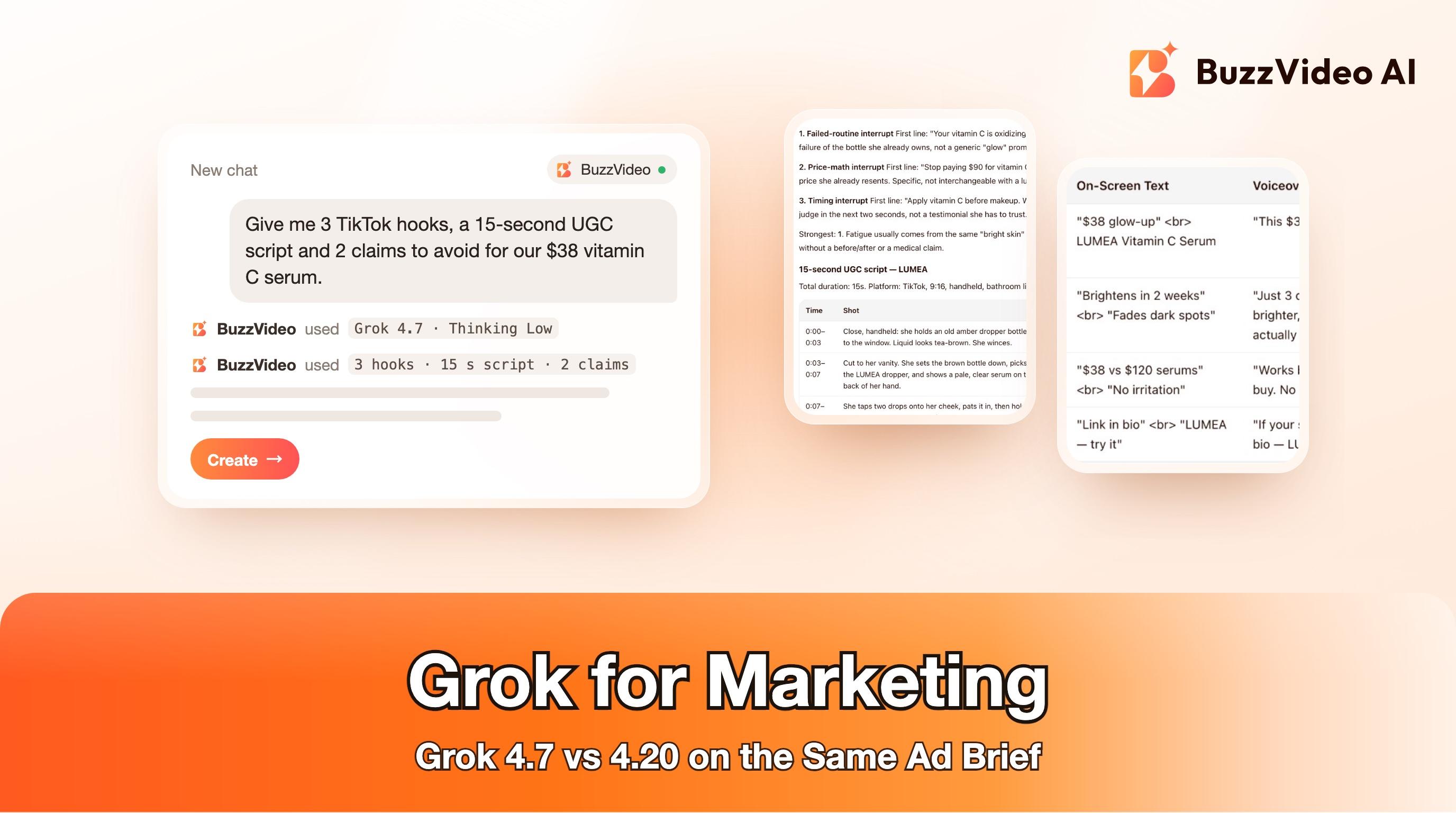
“Text only, please don't generate any images or videos. I run ads for LUMEA, a fictional $38 vitamin C serum for US women aged 25-40, and our TikTok ads are fatiguing. 1) Give me 3 new hook angles, each with a first line under 10 words. 2) Pick the strongest one and write a 15-second UGC script as a table: time, shot, on-screen text, voiceover. 3) List 2 claims we must avoid for ad compliance, and why.”
- Test brief used for every model
We timed each run and read the credit balance before and after. The balance came from a shared team workspace, so credit numbers are approximate.
Grok 4.7 vs Grok 4.20: what did each one write?
Grok 4.7: specific hooks and a script that follows its own rules
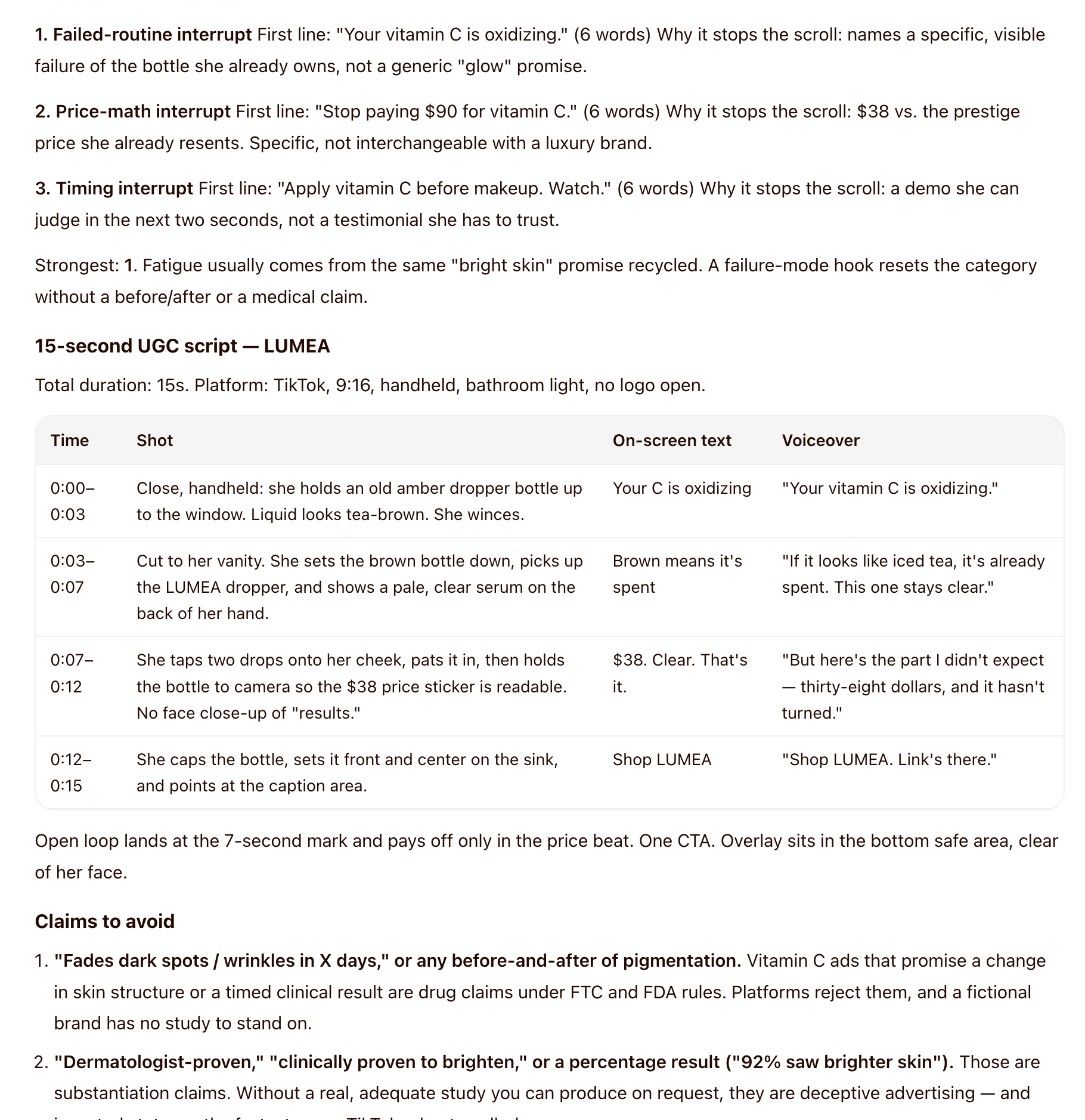
All three hooks were six words and each was built on a different, concrete angle: "Your vitamin C is oxidizing." (a visible failure of the bottle she already owns), "Stop paying $90 for vitamin C." (price math) and "Apply vitamin C before makeup. Watch." (a demo). It picked the oxidation hook and explained why in a sentence marketers will recognise: fatigue usually comes from the same "bright skin" promise recycled, and a failure-mode hook resets the category without a before-and-after or a medical claim.
The script was a tight four-row table with production notes: an open loop at the 7-second mark, one CTA, and overlays in the bottom safe area. Its compliance section named timed results ("fades dark spots / wrinkles in X days") and borrowed authority ("dermatologist-proven", "92% saw brighter skin") as the two claims to avoid, and it did not invent study numbers of its own.
It wasn't perfect. The voiceover line "This one stays clear" and "it hasn't turned" quietly imply a stability claim we never gave it, and it added a "$38 price sticker" to the bottle. Small, but exactly what slips into a final ad if nobody checks.
Grok 4.20: fast and cheap, but the script breaks its own compliance advice
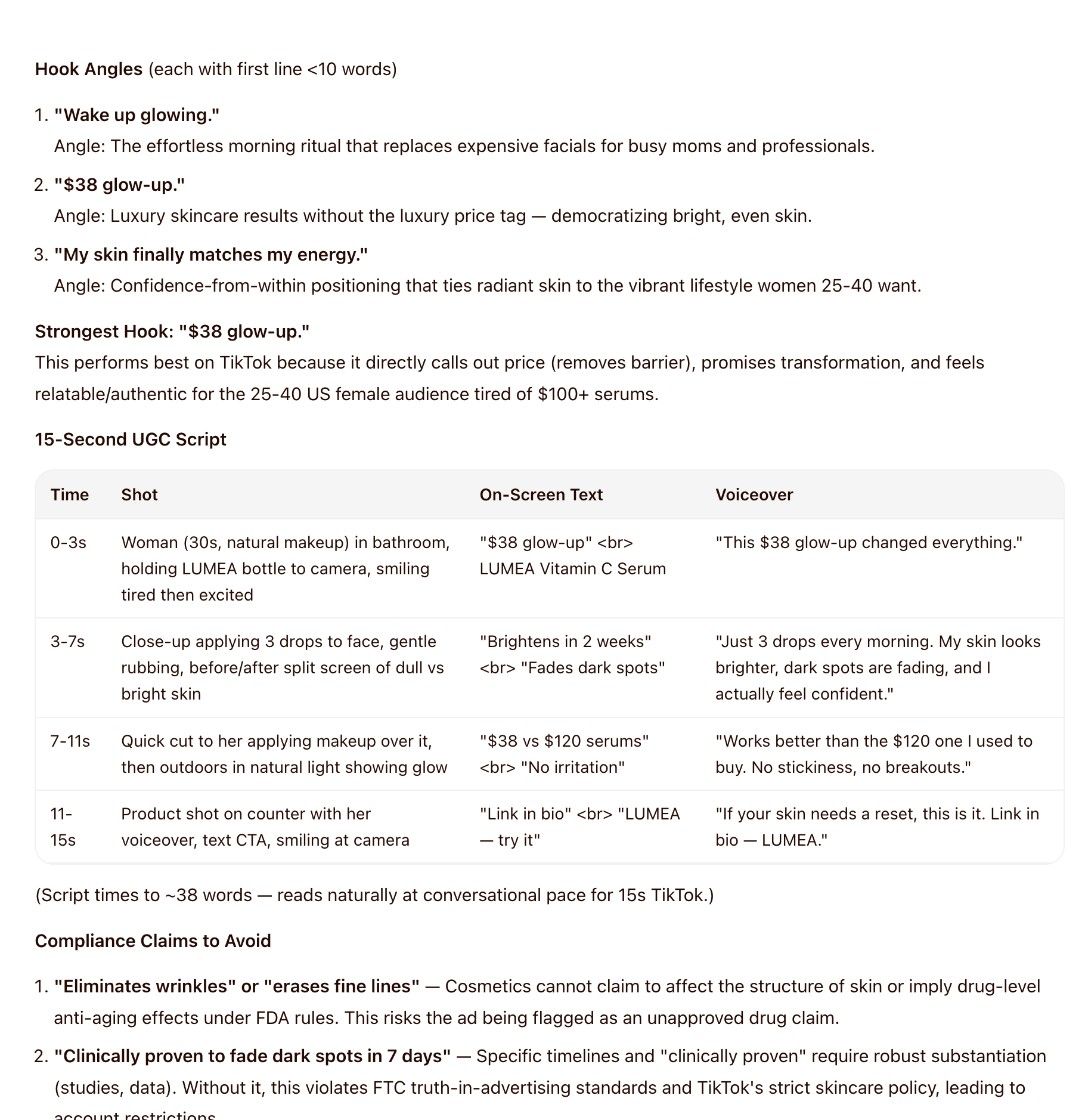
Grok 4.20's hooks were generic: "Wake up glowing.", "$38 glow-up." and "My skin finally matches my energy." Any skincare brand could run them.
The real problem is the script. Its on-screen text says "Brightens in 2 weeks" and "Fades dark spots", the shot list calls for a before/after split screen, and the voiceover claims it "works better than the $120 one I used to buy". Then, a few lines lower, its own compliance section warns against "Clinically proven to fade dark spots in 7 days" and against structure claims like "eliminates wrinkles". The advice is right; the script it wrote ignores it. If you shipped that script, you'd be running the claims the model told you to avoid.
The lesson: a model can give a correct checklist and still write copy that fails it. Check the script against the list.
How fast and how expensive is each Grok?
| Grok 4.7 | Grok 4.20 | |
|---|---|---|
| First text appeared | ~20 s | ~15 s |
| Full answer | ~33 s | ~21 s |
| Credits for this brief (approx.) | ~24 | ~6 |
| Hooks | Specific: oxidation, price math, demo | Generic: glow, price, confidence |
| Script vs its own compliance list | Consistent, one implied claim | Contradicts it (timed and dark-spot claims) |
| Unsupported details or claims | "$38 price sticker", implied stability | "No irritation", competitor comparison |
Times and credits are from our single run of each model on November 10, 2026, with Thinking on Low. Marketing Agent chat is billed in credits by usage, so there is no fixed price per message: a longer brief, a higher Thinking level or a longer answer will cost more. For context, the Starter plan includes 1,900 credits a month, so even Grok 4.7 at about 24 credits per brief leaves plenty of room. See the pricing page for current plans.
Which Grok model should you pick for marketing?
| Model | Picker description in BuzzVideo | Use it for | Tested by us? |
|---|---|---|---|
| Grok 4.7 | Latest Grok for real-time trends | Hooks, scripts and briefs you'll actually run | Yes |
| Grok 4.6 | For real-time trends and news | A fallback if 4.7 is slow or busy | No |
| Grok 4.5 | Earlier Grok, steady and fast | Repeatable, structured tasks | No |
| Grok 4.3 | Low cost for light tasks | Rewrites, captions, tone tweaks | No |
| Grok 4.20 | Lowest-cost Grok for quick answers | Brainstorm lists, quick factual questions, drafts you'll rewrite | Yes |
We only tested Grok 4.7 and Grok 4.20, so the middle three rows are based on xAI's descriptions and BuzzVideo's picker, not on our own output. A sensible rule: brainstorm cheaply on Grok 4.20 or 4.3, then move the angle you like to Grok 4.7 for the final script and compliance pass.
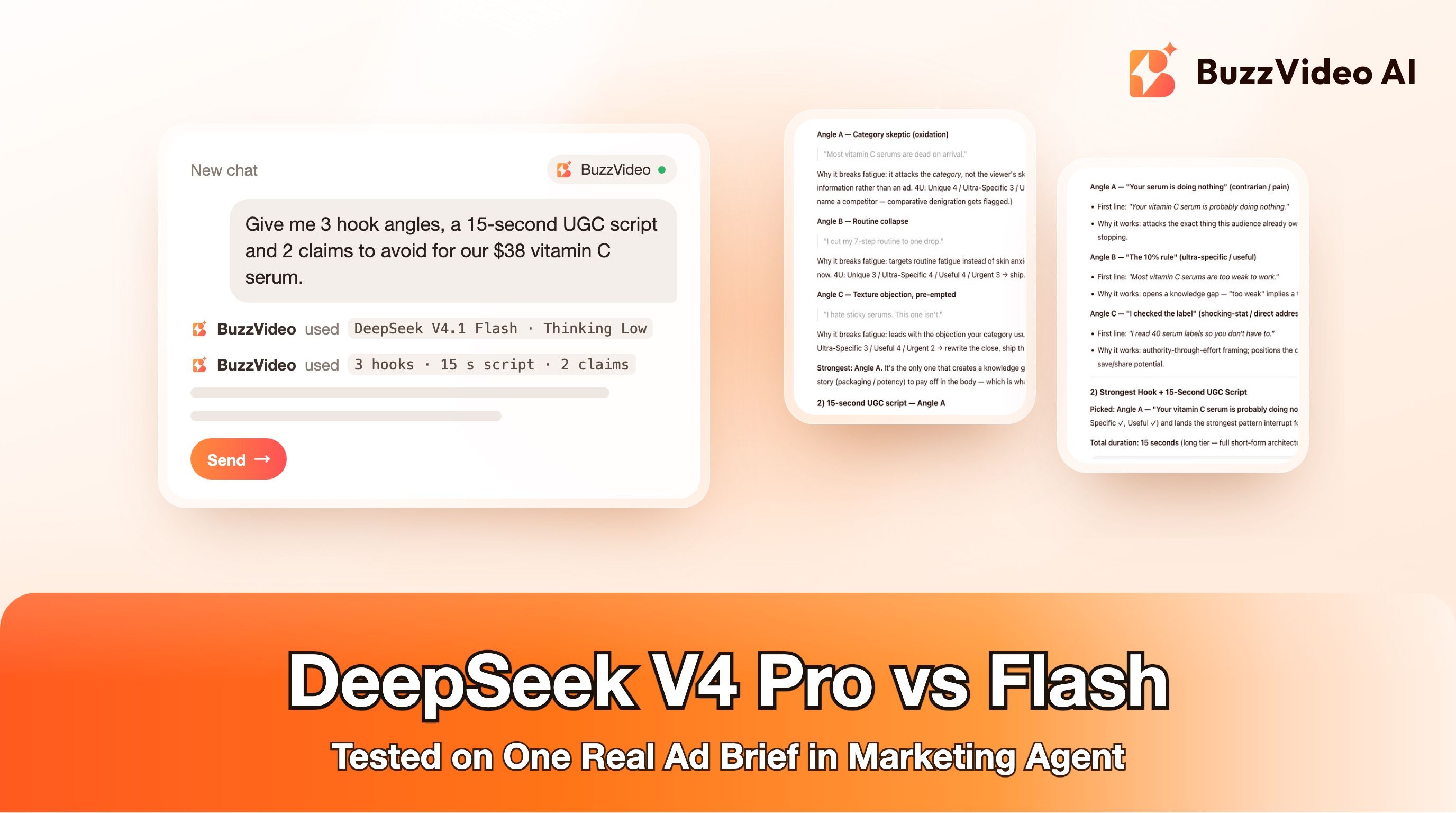
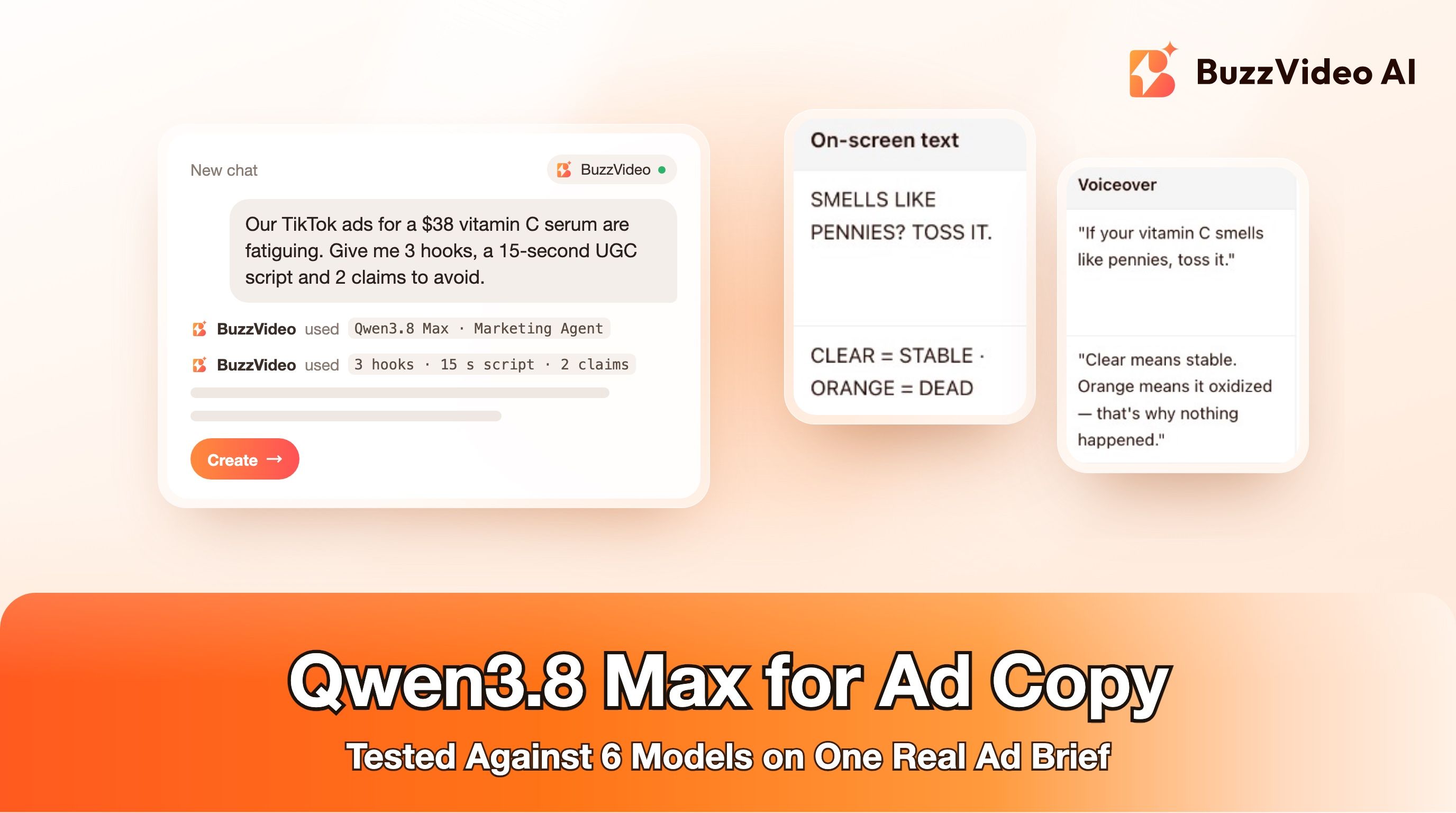
Grok isn't always the best pick, either. In the same test, DeepSeek V4.1 Flash used about 2 credits and gave one of the sharpest compliance answers, and Qwen3.8 Max was the most thorough (caption, hook variants, disclosure notes) but took over two minutes. If you want depth over speed, a slower reasoning model may serve you better than any Grok.
How do you prompt Grok for ad copy?
Every model we tested, Grok included, invented product facts we never supplied: packaging, actives, stability. The fix is in the brief, not the model. Give Grok the facts it may use and the claims it may not make, and ask it to check its own script.
“Text only. Brand: [BRAND], a [PRICE] [PRODUCT] for [AUDIENCE] in the [US/UK]. Channel: [TikTok / Reels / Meta feed], 9:16.
- Grok ad-copy brief template
Facts you may use (nothing else): [PACKAGING], [KEY INGREDIENTS AND %], [PRICE], [OFFER], [PROOF WE CAN SHOW, e.g. texture, routine order].
Claims we cannot make: [e.g. timed results, treats or cures, clinically proven, before/after, competitor comparisons].
1) Give me 3 hook angles, each with a first line under 8 words, built on different reasons to stop scrolling.
2) Write a [15]-second UGC script for the strongest one as a table: time, shot, on-screen text, voiceover.
3) Re-read your script and list any line that breaks the claims list or uses a fact I didn't give you, then fix it.”
Step 3 is what would have caught Grok 4.20's "Brightens in 2 weeks". Treat any compliance notes the agent gives you as a starting point, not legal advice; for regulated categories like skincare, supplements and finance, have someone qualified review the final claims.
When is Grok not the right choice?
- You need current trends or news. The picker describes Grok 4.7 and 4.6 as models for real-time trends, but we ran our test with Web Explore off. Turn on Web Explore when the answer depends on what is happening this week, and check the sources it cites.
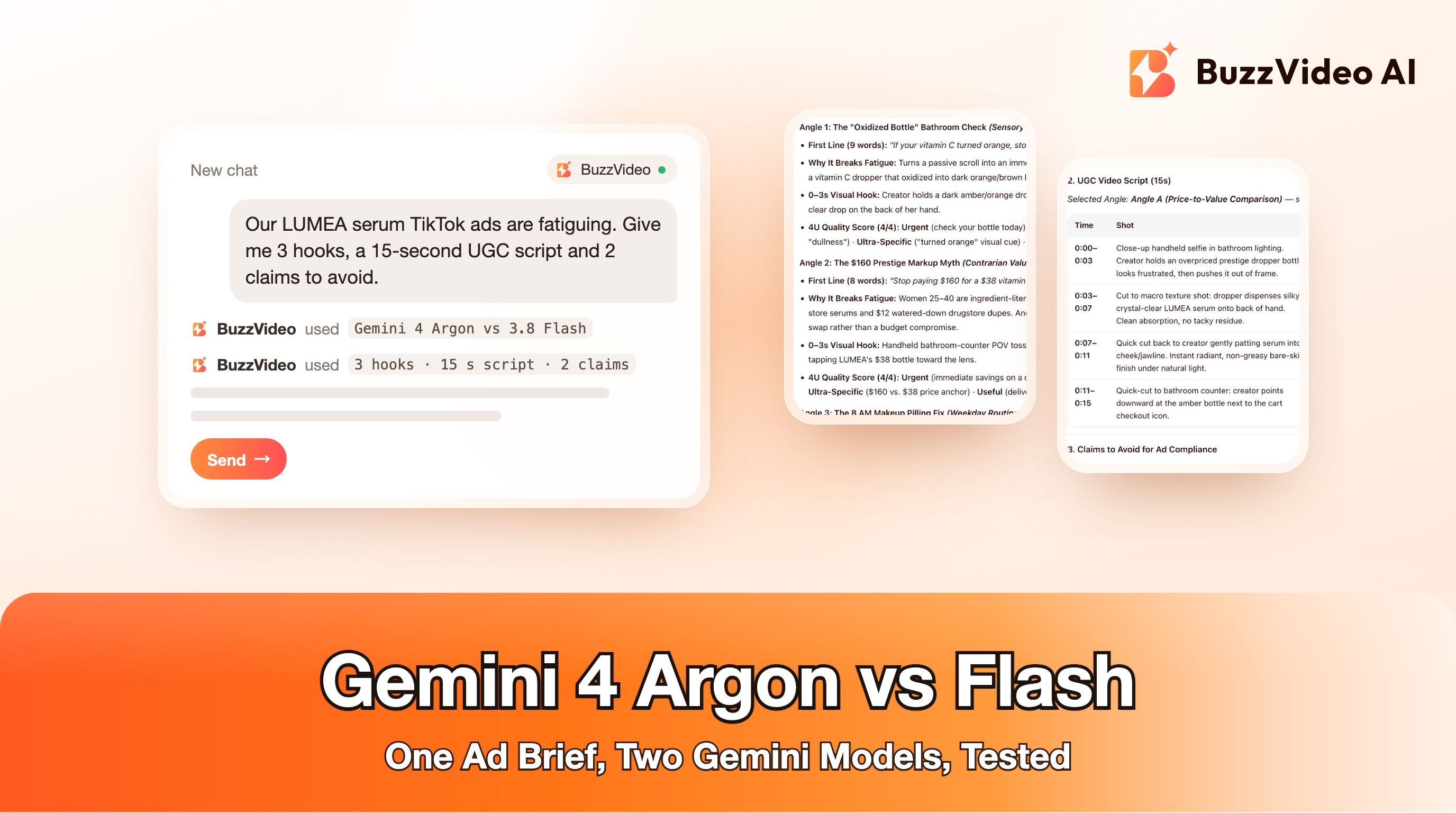
- You want the deepest reasoning on a complex brief. Slower reasoning models such as Gemini 4 Argon or Qwen3.8 Max gave longer, more detailed compliance answers in our test, at a similar or higher credit cost.
- You're on a tight credit budget and need volume. DeepSeek V4.1 Flash used about a twelfth of Grok 4.7's credits on the same brief.
- You'd ship the first draft unedited. No model in our test was safe to run without a human read, and the cheapest Grok was the riskiest.
When the script is ready, Marketing Agent can hand it to Generate Video in the same chat, so the brief, the script and the clip live together. If you use AI-generated people in the final ad, label them: our guide to AI ad labels covers Meta and TikTok.
Ready to test Grok on your own brief? Open Marketing Agent, pick Grok 4.7, paste the template above, then try the same brief on Grok 4.20 and compare.
FAQs
Is Grok good for marketing?
Grok 4.7 is good for short, punchy ad copy: in our test it wrote specific six-word hooks and a 15-second script that respected its own compliance advice. The cheapest Grok, 4.20, was faster but generic and wrote claims it had just warned against.
What is the difference between Grok 4.7 and Grok 4.20?
Grok 4.7 is xAI's newest flagship, announced in September 2026, with a 500k-token context window. Grok 4.20 dates from March 2026 and is the lowest-cost Grok in BuzzVideo; in our test it used about a quarter of Grok 4.7's credits but produced weaker, riskier copy.
Which Grok model is best for writing ad copy?
Grok 4.7, based on our side-by-side test. Use Grok 4.20 or 4.3 for cheap brainstorming and rewrites, then finish the script on Grok 4.7.
Can I use Grok in BuzzVideo?
Yes. Grok 4.7, 4.6, 4.5, 4.3 and 4.20 are in the Marketing Agent model picker, next to Gemini, Qwen and DeepSeek models. You can also connect BuzzVideo to ChatGPT or Claude through BuzzVideo MCP.
How much does it cost to use Grok in BuzzVideo?
Chat is billed in credits by usage, with no fixed price per message. Our test brief used about 24 credits on Grok 4.7 and about 6 on Grok 4.20; the Starter plan includes 1,900 credits a month.
Is Grok 4.20 the same as Grok Imagine?
No. Grok 4.20 and the other Grok 4.x models are chat models that write text. Grok Imagine is xAI's separate image model, which BuzzVideo offers under image generation.
Does Grok make up product facts?
It can. Both Grok models added details we never gave them, and so did every other model we tested. List the facts it may use and the claims it may not make in your brief.
Last verified: November 10, 2026, against our live pricing and product pages.
Next reads: Gemini 4 Argon vs 3.8 Flash · Qwen3.8 Max for marketing · DeepSeek V4 Pro vs Flash · AI UGC ads that don't look fake · Ship 50 ad variants in a week · How to label AI ads on Meta and TikTok · BuzzVideo pricing: cost per ad

About the author
Monica
Product Manager
As a Product Manager at BuzzVideo AI, I work with marketers and growth teams on AI ad workflows—from brief to shippable creatives. I write about practical product workflows, model choices, and how teams turn product pages into ads that feel native on Meta and TikTok.