Claude for Marketing: Opus 5.5 vs Sonnet 5.5 vs Haiku 5.5
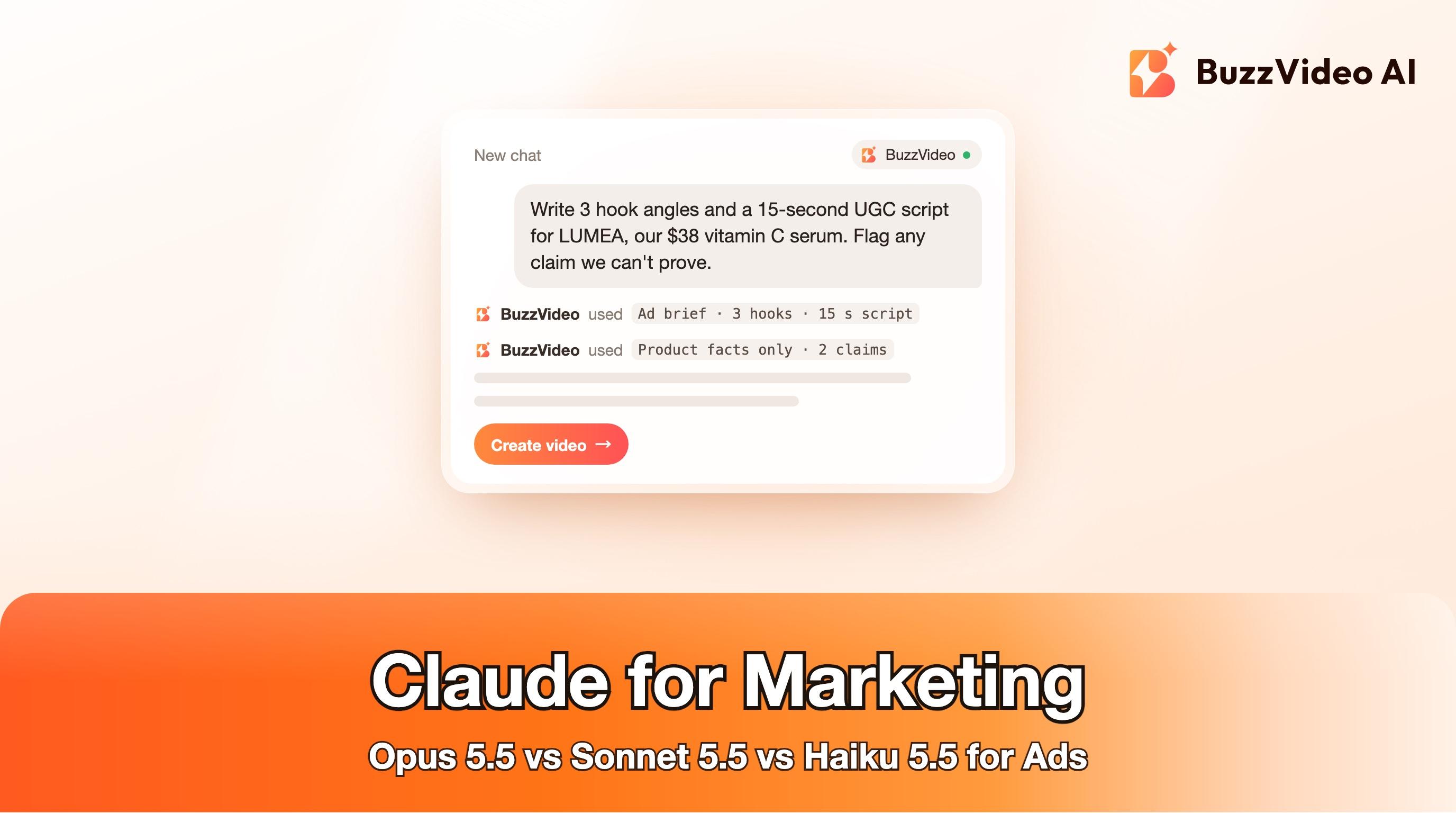
Which Claude model to use for marketing: Opus 5.5, Sonnet 5.5 or Haiku 5.5 for ad strategy, hooks and scripts, plus a brief template that stops invented claims.
For marketing work, start with Claude Opus 5.5 for strategy, research and long briefs, and use Claude Sonnet 5.5 when you want faster day-to-day copy such as hooks, scripts and captions. Claude Haiku 5.5 is built for high-volume sorting jobs like tagging ad comments, not for your hero copy. With any of them, the copy is only as accurate as the brief: give Claude your real product facts and the claims you can prove, and it has far less room to fill gaps.
BuzzVideo's Marketing Agent turns a brief like that into hooks, scripts and finished image and video ads. This guide covers Anthropic's Claude family using Anthropic's own documentation: which model fits which marketing task, what each is good and bad at for ad copy, and a copy-paste brief built from what we learned giving the same ad task to seven chat models.
Try it: Paste the brief template from this guide into Marketing Agent with your own product facts, then send the script to Generate Video. Open Marketing Agent →
What is Claude?
Claude is the family of language models made by Anthropic. The current lineup, per Anthropic's models overview, is Claude Fable 5.2, Claude Opus 5.5 (released September 22, 2026), Claude Sonnet 5.5 (September 28, 2026) and Claude Haiku 5.5 (October 7, 2026). Older models are still offered, including Claude Fable 5.1, Fable 5, Opus 5 and Sonnet 5. What they share:
- Every current Claude model reads text and images and writes text. You can paste in a screenshot of a competitor's ad or a product photo, but Claude writes; it doesn't generate images or video.
- Each has a 1 million token context window and can write up to 128,000 tokens in one answer.
- The current models have a reliable knowledge cutoff of June 2026. Anything newer, like this season's trends, has to come from you or from a web search.
- Thinking is adaptive: the model decides how much to reason, steered by an effort setting.
Anthropic's own advice is short: "If you're unsure which model to use, start with Claude Opus 5.5 for most workloads."
Claude Opus 5.5 vs Sonnet 5.5 vs Haiku 5.5: which fits which marketing task?
| Model | Anthropic's description | Status | Best ad use (our view) |
|---|---|---|---|
| Claude Opus 5.5 | "For long-running agentic coding and knowledge work" | Current, Sep 22, 2026 | Campaign strategy, research, sourced briefs, long brand documents |
| Claude Sonnet 5.5 | "The best combination of speed and intelligence" | Current, Sep 28, 2026 | Day-to-day hooks, scripts, captions and variants |
| Claude Haiku 5.5 | "For high-volume, latency-sensitive tasks such as classification, extraction, and routing" | Current, Oct 7, 2026 | Tagging comments, pulling themes from reviews |
| Claude Fable 5.1 | "For demanding reasoning and long-horizon agentic work" | Legacy, Sep 1, 2026 (Fable 5.2 is current) | Hard, multi-step strategy work |
| Claude Opus 5 | Legacy; Anthropic suggests moving to Opus 5.5 | Legacy, Jul 24, 2026 | Superseded by Opus 5.5 |
| Claude Sonnet 5 | Legacy; Anthropic suggests moving to Sonnet 5.5 | Legacy, Jun 30, 2026 | Superseded by Sonnet 5.5 |
| Claude Fable 5 | Legacy; Anthropic suggests moving to Fable 5.2 | Legacy, Jun 9, 2026 | Superseded by Fable 5.2 |
Descriptions, release dates and status are from Anthropic's model pages on November 10, 2026. The last column is our recommendation, not an Anthropic claim.
A simple rule: use Opus 5.5 when the thinking is the hard part, such as choosing an angle for a launch, auditing a quarter of ads against reviews, or writing a brief that a whole team will work from. Use Sonnet 5.5 when you already know the angle and need good copy quickly. Haiku 5.5 is the right tool when the job is sorting, not writing.
What is Claude good at for ad strategy, copy and scripts?
Anthropic's launch posts make a few claims that matter directly to marketers:
- Following your writing rules. Anthropic says Opus 5.5 "follows the writing rules you give it" and "puts the most important information up front" (Opus 5.5 announcement). That suits brand voice guides and banned-word lists.
- Not inventing figures in sourced work. In Anthropic's sourced-report test, where "any invented figure or quote would have failed", 16 of 18 Opus 5.5 reports passed; neither Fable 5.1 nor Opus 5 passed in any attempt (same post). That measures reports built from supplied sources, which is exactly why you should supply yours.
- Clearer, faster drafting. Anthropic says Sonnet 5.5 "writes more clearly than our previous generation of models" and generates outputs "30%+ faster than Sonnet 5" (Sonnet 5.5 announcement).
- Speed and cost at volume. Anthropic calls Haiku 5.5 "our fastest model to date" and positions it for classification and extraction (Haiku 5.5 announcement). It doesn't pitch Haiku for writing.
And the habits to plan around. Claude needs to be told what you want: Anthropic's prompting guide says that if you want more than the task strictly requires, you should ask for it explicitly rather than hope the model infers it. The same guide notes that Opus 5 writes longer answers by default, so ask for brevity if you still use it.
How do you brief Claude for ad copy?
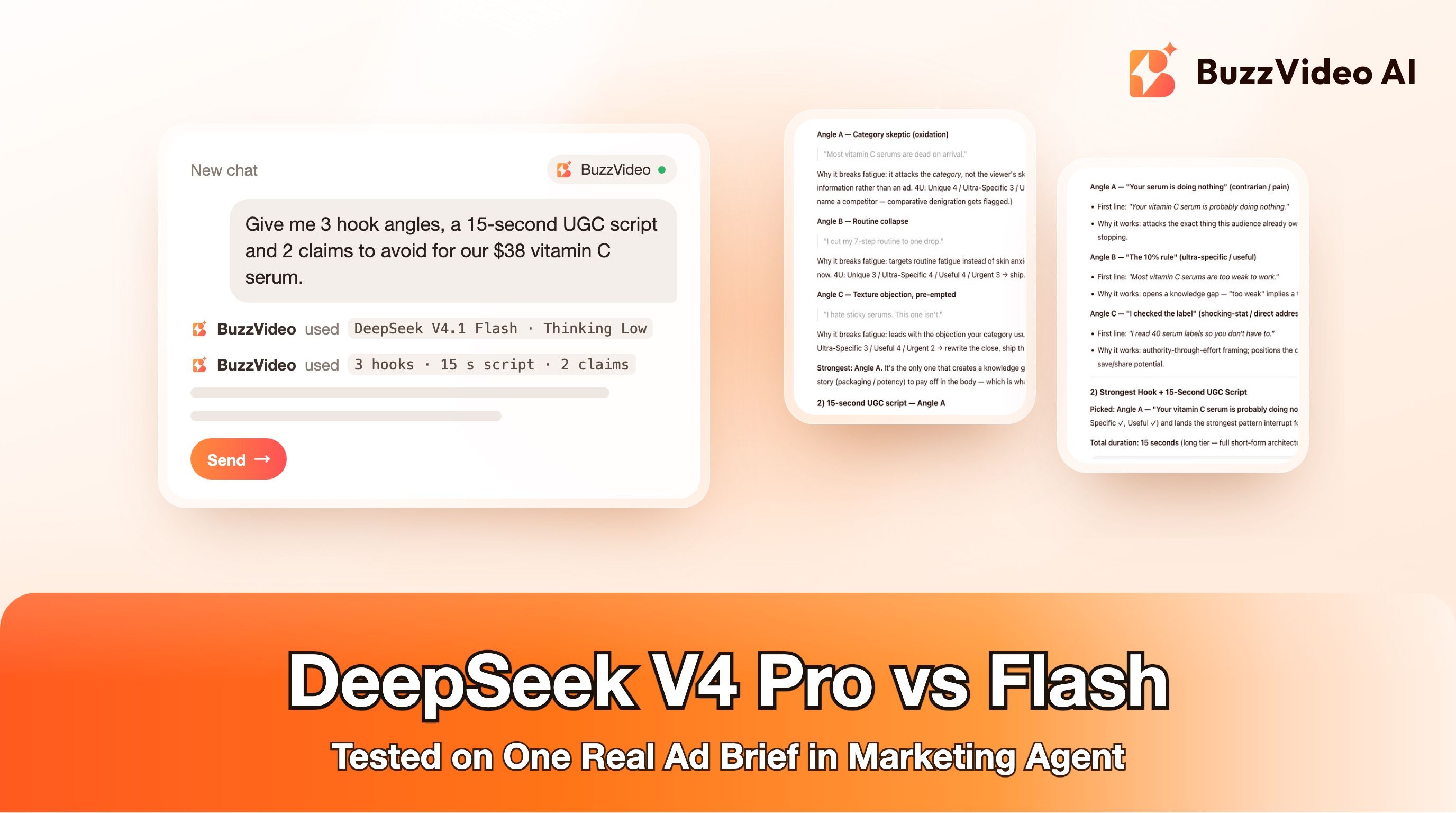
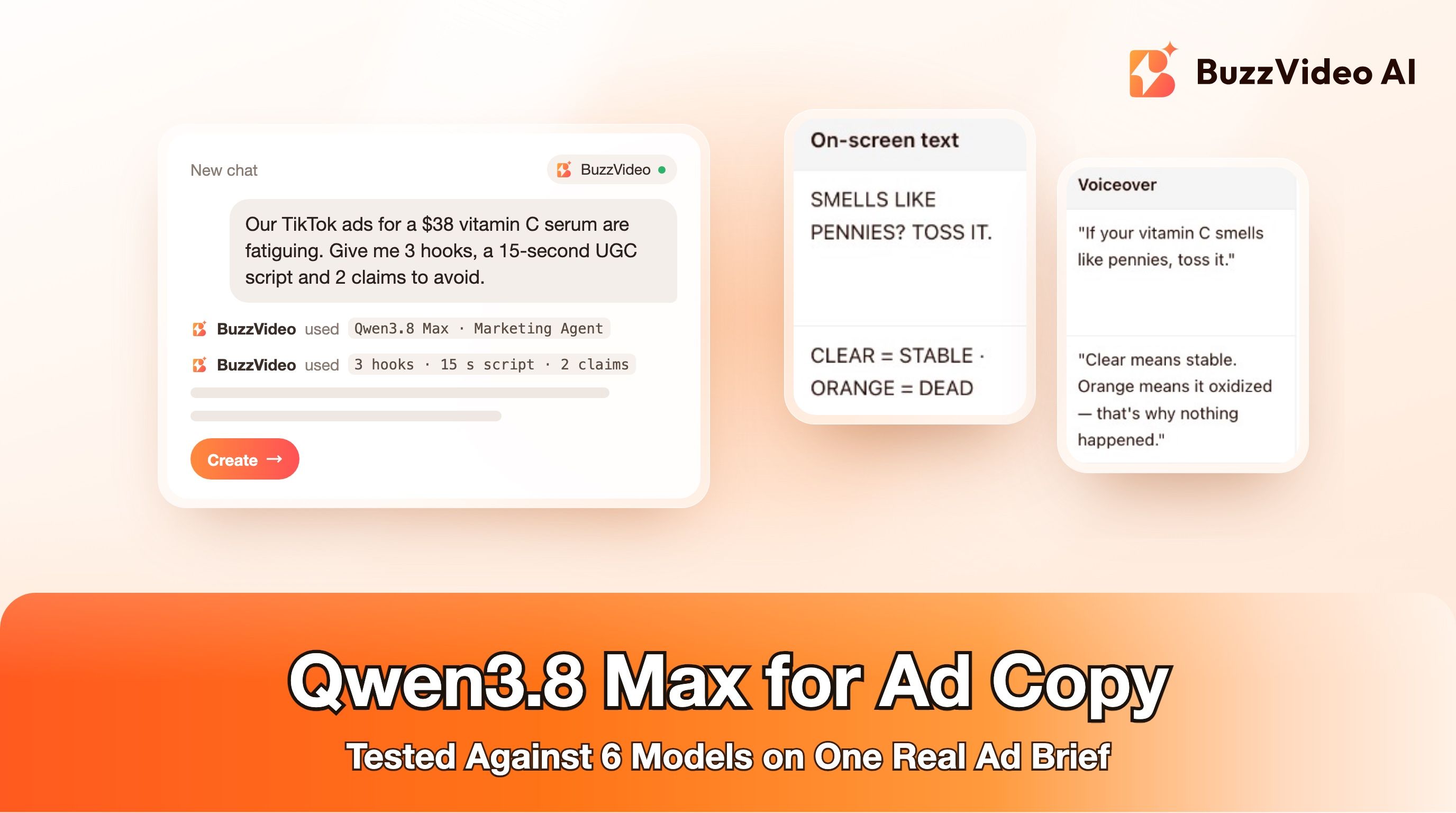
In November 2026 we gave the same short ad brief to seven chat models in Marketing Agent, from Google, xAI, Alibaba (Qwen) and DeepSeek: three hook angles, a 15-second UGC script and two claims to avoid, for LUMEA, a fictional $38 vitamin C serum. Every model invented product facts we never supplied, including an airless pump, a 15% vitamin C concentration and a sealed dark-glass bottle. One wrote a script with the same dark-spot and before-and-after claims its own compliance section told us to avoid. We haven't run Claude through that test yet, and Anthropic's honesty results don't cover facts that were never in the brief, so the brief has to close the gaps.
Anthropic's prompting guide describes Claude as a "brilliant but new employee who lacks context on your norms". Brief it the way you'd brief a new freelancer:
- Say who it is and why the work matters. Anthropic recommends giving the reason behind instructions, because Claude generalises from it: "Our TikTok ads are fatiguing after two weeks, so we need new angles, not new wording."
- Give product facts, and only those. Price, size, key ingredients or specs, packaging and anything you can prove, with the line "use only these facts; if you need one that isn't here, ask me".
- Name the claims you can't make, and ask Claude to flag any line that comes close.
- Separate the parts. Anthropic recommends keeping instructions, context and examples clearly apart; its docs use tags for this. In a brief, labels such as PRODUCT FACTS and CLAIMS WE CAN'T MAKE serve the same purpose.
- Show examples. Anthropic calls examples one of the most reliable ways to steer format and tone, and suggests three to five. Paste your best past hooks and label them as examples.
- Say the format positively. Anthropic suggests asking for what you want ("flowing prose paragraphs") rather than what you don't ("no markdown").
Copy-paste template
“ROLE: You are a performance creative strategist for [BRAND], a [PRODUCT] sold at [PRICE] to [AUDIENCE] in the US. Our [PLATFORM] ads are [PROBLEM], so we need new angles, not just new wording.
- Claude ad brief template
PRODUCT FACTS (use only these; if you need a fact that isn't here, ask me instead of assuming): [KEY INGREDIENTS OR SPECS], [PACKAGING], [SIZE], [WHAT WE CAN PROVE, AND THE SOURCE].
CLAIMS WE CAN'T MAKE: [E.G. TREATS, CURES, CLINICALLY PROVEN, BEFORE-AND-AFTER RESULTS].
EXAMPLES OF HOOKS THAT WORKED FOR US: [2–3 PAST HOOKS].
TASK:
1) Give me 3 hook angles that are clearly different from each other and from the examples, each with a first line under 10 words.
2) Pick the strongest and write a 15-second UGC script as a table: time, shot, on-screen text, voiceover.
3) Flag any line in your script that could read as a claim we can't prove.
Write the voiceover as natural, spoken American English.”
How did Claude do in our Marketing Agent test?
[PLACEHOLDER — run the standard LUMEA brief after launch] Add the Claude models tested and their thinking level, time to first text and total time, approximate credits, the three hooks and the chosen script (short verbatim quotes), the compliance answer, any invented product facts, and one or two cropped screenshots.
What does an ad brief cost in Marketing Agent?
Marketing Agent chat is billed in credits by usage, so there is no fixed price per message. For reference, here is what the identical LUMEA brief used on the models in the picker today:
| Model (in Marketing Agent today) | First text | Total | Credits, approx. |
|---|---|---|---|
| Gemini 4 Argon | ~3.5 min | ~4 min | ~30 |
| Gemini 3.8 Flash | 15 s | 23 s | ~7 |
| Grok 4.7 | 20 s | 33 s | ~24 |
| Grok 4.20 | 15 s | 21 s | ~6 |
| Qwen3.8 Max | 90 s | 135 s | ~29 |
| DeepSeek V4 Pro | 13 s | 29 s | ~12 |
| DeepSeek V4.1 Flash | 27 s | 34 s | ~2 |
Times and credits are from our runs on November 10, 2026, with thinking on Low where the model offers it. Credits were read from a shared team workspace balance between runs, so treat them as approximate. See the pricing page for plan credits.
When is Claude not the right choice?
- You need this week's trends. Current Claude models' reliable knowledge runs to June 2026. For live trends, use a model with web access or paste the trend in yourself.
- You need the image or the video itself. Claude writes; it doesn't render. Hand its script to an image or video model to make the ad.
- You're writing hero copy on Haiku. Anthropic positions Haiku 5.5 for classification, extraction and routing. Use it to sort, then write with Sonnet or Opus.
- You need a legal answer. Any model's compliance notes are a starting point, not legal advice. Have someone qualified check claims before you spend on media.
If the finished ad uses AI-generated people or voices, label it. Our guide to AI ad labels covers what Meta and TikTok require.
Ready to brief your next ad? Open Marketing Agent, paste the template with your real product facts, and send the script to Generate Video when it reads right.
FAQs
Which Claude model is best for marketing?
Anthropic suggests starting with Claude Opus 5.5 for most workloads. For marketing, we'd use Opus 5.5 for strategy and research and Sonnet 5.5 for faster day-to-day copy.
Claude Opus 5.5 vs Sonnet 5.5: which is better for copywriting?
Opus 5.5 is Anthropic's choice for long, demanding knowledge work and follows writing rules closely. Sonnet 5.5 writes more clearly than the previous generation and is faster, which suits high-volume hooks and captions.
Is Claude good for ad copy?
Anthropic says Opus 5.5 follows the writing rules you give it and Sonnet 5.5 writes more clearly than the previous generation. Results still depend on the brief: give it product facts, banned claims, example hooks and an exact output format.
What is Claude's knowledge cutoff?
June 2026 for Claude Opus 5.5, Sonnet 5.5, Haiku 5.5 and Fable 5.1. Older models are earlier: May 2026 for Opus 5 and January 2026 for Fable 5 and Sonnet 5.
Can Claude create images or videos for ads?
No. Claude accepts text and images as input but only writes text. Use its script or prompt with an image or video model to make the ad.
Is Claude Fable better than Opus for marketing?
Fable is Anthropic's line for the most demanding reasoning and long-horizon agent work, and Fable 5.2 has replaced Fable 5.1. For most ad strategy and copy, Anthropic's default recommendation is Opus 5.5.
How do I stop Claude from inventing product facts?
List the facts it may use, tell it to ask rather than assume when something is missing, name the claims you can't make, and ask it to flag risky lines. In our tests, every model invented at least one product detail we hadn't given it.
Last verified: November 10, 2026, against our live pricing and product pages.
Next reads: How to ship 50 ad variants in a week · AI UGC ads that don't look fake · How to label AI ads on Meta and TikTok · What an ad costs on BuzzVideo

About the author
Monica
Product Manager
As a Product Manager at BuzzVideo AI, I work with marketers and growth teams on AI ad workflows—from brief to shippable creatives. I write about practical product workflows, model choices, and how teams turn product pages into ads that feel native on Meta and TikTok.