GPT-6 Astra vs Sol vs Luna: Which to Use for Ads
GPT-6 Astra, Sol or Luna for ad strategy, hooks and scripts? What OpenAI says each model is for, how to brief it, and how to stop it inventing product facts.
For ad work, GPT-6 Astra is OpenAI's model for the hardest thinking, such as a campaign strategy or an audit of dozens of ads at once. GPT-6.1 Sol is the lower-cost, near-Astra option for everyday briefs, hooks and scripts, and GPT-6 Luna is built for high-volume jobs like rewriting thirty hook variants. Whichever you pick, the copy is only as accurate as your brief: give the model your real product facts and the claims you can prove, and tell it exactly how to format the answer.
BuzzVideo's Marketing Agent turns a brief like that into hooks, scripts and finished image and video ads. This guide covers the GPT-6 family using OpenAI's own documentation: what each model is for, how they compare, what they're good and bad at for ad copy, and a copy-paste brief built from what we learned giving the same ad task to seven chat models.
Try it: Paste the brief template from this guide into Marketing Agent with your own product facts, then send the script to Generate Video. Open Marketing Agent →
What is GPT-6?
GPT-6 is OpenAI's current generation of language models. The flagship, GPT-6 Astra, was released on September 3, 2026, followed by the faster and cheaper GPT-6 Sol and GPT-6 Luna, and by GPT-6.1 Sol on September 29, 2026. According to OpenAI's model documentation:
- Every GPT-6 model reads text and images and writes text. You can paste in a screenshot of a competitor's ad or a product photo, but the model writes; it doesn't generate images or video.
- Each model has a context window of about 1.05 million tokens and can write up to 128,000 tokens in one answer.
- Knowledge cutoffs are April 30, 2026 for Astra and GPT-6.1 Sol, April 20, 2026 for GPT-6 Sol and May 18, 2026 for GPT-6 Luna. Anything newer, like this season's trends or a competitor's latest launch, has to come from you or from a web search.
- Reasoning effort is adjustable from low to max. GPT-6 Sol and Luna also accept none, for the fastest answers on simple tasks.
OpenAI's GPT-6 Astra system card reports that Astra makes "substantially fewer factual errors" than GPT-5.6 Sol. That's about general knowledge, not your product. No model knows your packaging, your active-ingredient percentages or your test results unless you put them in the brief.
GPT-6 Astra vs Sol vs Luna: which model fits which ad task?
| Model | OpenAI's description | Knowledge cutoff | Best ad use (our view) |
|---|---|---|---|
| GPT-6 Astra | "Our most capable model for the most demanding work" | Apr 30, 2026 | Campaign strategy, positioning, auditing many ads or reviews at once |
| GPT-6.1 Sol | "Near-Astra performance for complex work at a lower cost" | Apr 30, 2026 | Everyday briefs, hooks and scripts that still need reasoning |
| GPT-6 Sol | "Built to power complex coding and agentic workflows" | Apr 20, 2026 | Same jobs as GPT-6.1 Sol, which OpenAI lists as the newer model |
| GPT-6 Luna | "Our most efficient model for focused, high-volume tasks" | May 18, 2026 | Bulk hook variants, headline trims, tagging ad comments |
| GPT-5.6 Luna | "GPT-5.6 model optimized for cost-sensitive workloads" | Feb 16, 2026 | Simple, repetitive text jobs at the lowest cost |
Descriptions and cutoffs are quoted from OpenAI's model pages on November 10, 2026. The last column is our recommendation based on those descriptions, not an OpenAI claim.
A simple rule: start with GPT-6.1 Sol. Move up to Astra when the brief is hard, for example when there are many inputs to weigh (reviews, past results, a brand book), when real budget rides on the answer, or when you can't yet say what the messaging problem is. OpenAI's GPT-6 guide says Astra was built to ask focused questions when the answer could change the outcome, which is what you want from a strategist. Move down to Luna when you already know the angle and need volume. OpenAI also lists GPT-6.1 Terra, which it describes as good at "clear, natural writing"; it's worth a look if polished long-form copy is your main job.
What is GPT-6 good at for ad strategy, copy and scripts?
From OpenAI's guide to using GPT-6, these are the strengths that matter for marketers.
- Long, detailed briefs. OpenAI says Astra "is better able to follow longer instructions". You can give it brand rules, banned words, the audience, the offer and the output format in one message.
- Lots of context. With a context window of about a million tokens, you can paste reviews, past scripts and performance notes and ask for patterns.
- Reading images. All GPT-6 models accept images, so you can ask what a competitor's ad is doing in its first three seconds, or have it describe your product photo for a video prompt.
- Structured deliverables. OpenAI notes that Astra "tends to use lists, tables and Markdown". That's useful for a script table with time, shot, on-screen text and voiceover columns.
And the habits to plan around:
- Formatting when you want prose. Because the default leans towards lists and tables, ask for plain paragraphs or a single line when you want caption copy or a voiceover read.
- Repeated phrases. OpenAI says the model "may use recurring phrases across sessions". For ad variants, ask for clearly different angles and list the phrases you've already used.
- Sensitivity to context. OpenAI warns Astra "can also be more sensitive to information in context". If you attach an old brand doc with outdated rules, say which instructions take priority.
How do you brief GPT-6 for ad copy?
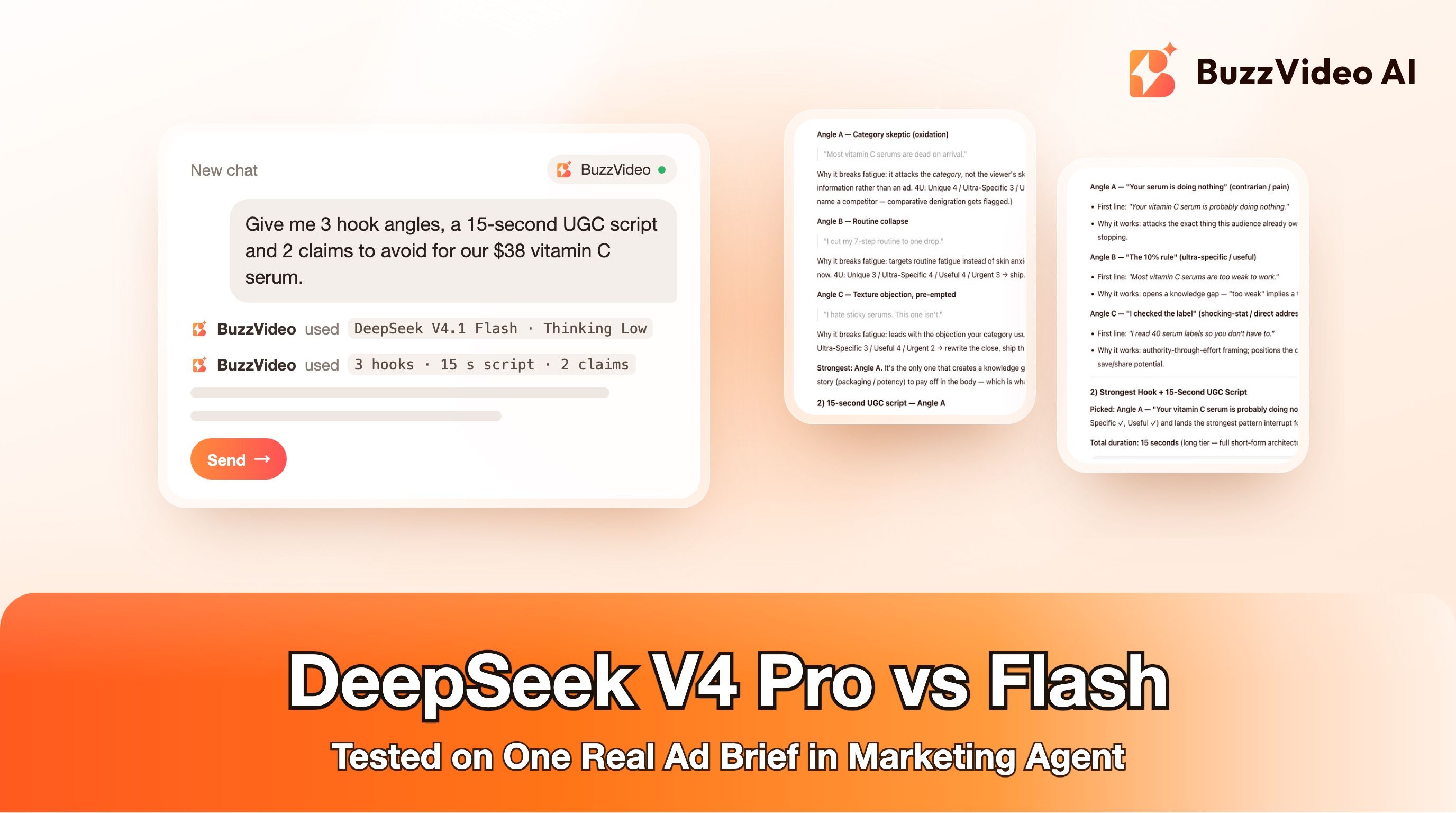
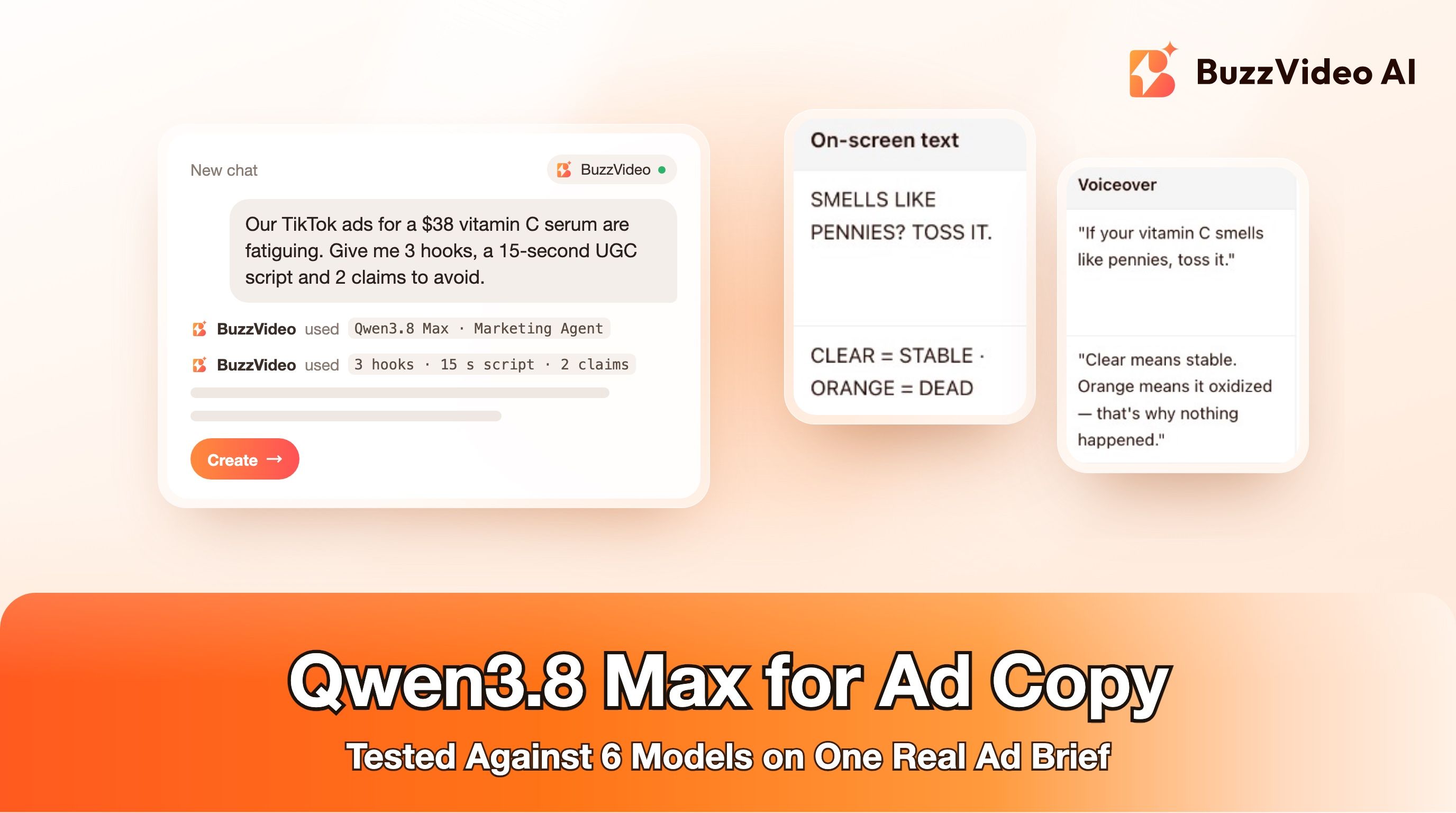
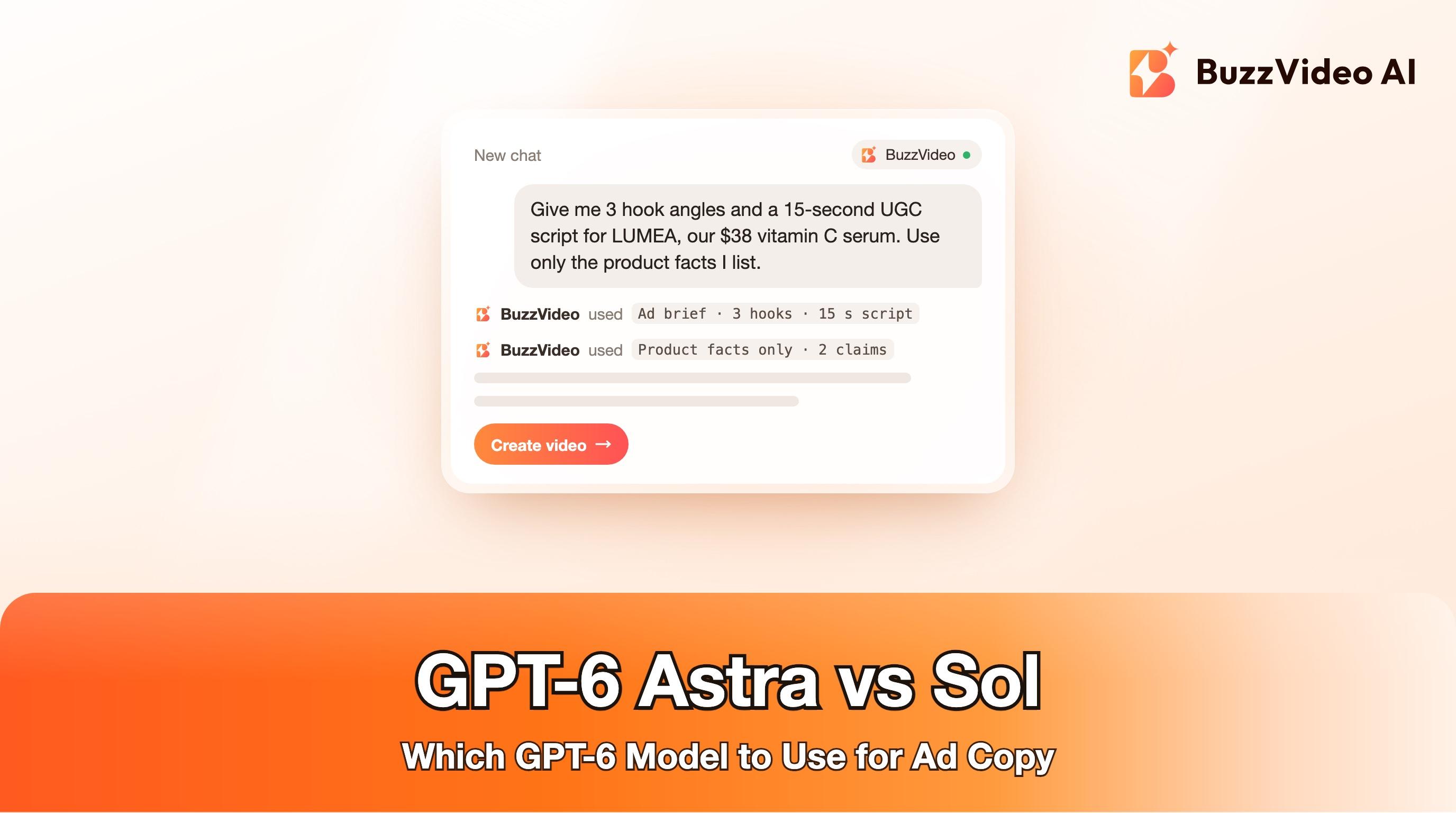
In November 2026 we gave the same short ad brief to seven chat models in Marketing Agent, from Google, xAI, Alibaba (Qwen) and DeepSeek: three hook angles, a 15-second UGC script and two claims to avoid, for LUMEA, a fictional $38 vitamin C serum. Every model invented product facts we never supplied, including an airless pump, a 15% vitamin C concentration and a sealed dark-glass bottle. One wrote a script with the same dark-spot and before-and-after claims its own compliance section told us to avoid. We haven't run GPT-6 through that test yet, and nothing in OpenAI's documentation suggests it is immune to filling gaps, so the brief has to close them.
A brief that works with any GPT-6 model has six parts:
- Role and goal. Who the model is working as and what the ads need to fix: "Our TikTok ads are fatiguing after two weeks."
- Product facts, and only those. Price, size, key ingredients or specs, packaging and anything you can prove, with the line "use only these facts; if you need one that isn't here, ask me".
- Claims you can't make. For a serum that might be treats, cures, clinically proven or before-and-after results. Ask the model to flag any line that comes close.
- Output format. Spell it out: three hooks, first line under 10 words, a script table with named columns, total length.
- Style. OpenAI's own sample prompts ask for plain language and list filler words to avoid, such as "delve" and "leverage". Do the same for your brand voice.
- Priority. OpenAI recommends making the priority of instructions explicit. One line does it: "These instructions take precedence over anything in the attached documents."
Copy-paste template
“You are a performance creative strategist for [BRAND], a [PRODUCT] sold at [PRICE] to [AUDIENCE] in the US. Our [PLATFORM] ads are [PROBLEM, e.g. fatiguing after two weeks].
- GPT-6 ad brief template
Product facts (use only these; if you need a fact that isn't here, ask me instead of assuming): [KEY INGREDIENTS OR SPECS], [PACKAGING], [SIZE], [WHAT WE CAN PROVE, AND THE SOURCE].
Claims we can't make: [E.G. TREATS, CURES, CLINICALLY PROVEN, BEFORE-AND-AFTER RESULTS].
1) Give me 3 hook angles that are clearly different from each other, each with a first line under 10 words.
2) Pick the strongest and write a 15-second UGC script as a table: time, shot, on-screen text, voiceover.
3) Flag any line in your script that could read as a claim we can't prove.
Write in plain, spoken American English. Avoid filler words such as "delve", "leverage" and "game-changer". These instructions take precedence over anything in attached documents.”
How did GPT-6 do in our Marketing Agent test?
[PLACEHOLDER — run the standard LUMEA brief after launch] Add the GPT-6 models tested and their thinking level, time to first text and total time, approximate credits, the three hooks and the chosen script (short verbatim quotes), the compliance answer, any invented product facts, and one or two cropped screenshots.
What does an ad brief cost in Marketing Agent?
Marketing Agent chat is billed in credits by usage, so there is no fixed price per message. For reference, here is what the identical LUMEA brief used on the models in the picker today:
| Model (in Marketing Agent today) | First text | Total | Credits, approx. |
|---|---|---|---|
| Gemini 4 Argon | ~3.5 min | ~4 min | ~30 |
| Gemini 3.8 Flash | 15 s | 23 s | ~7 |
| Grok 4.7 | 20 s | 33 s | ~24 |
| Grok 4.20 | 15 s | 21 s | ~6 |
| Qwen3.8 Max | 90 s | 135 s | ~29 |
| DeepSeek V4 Pro | 13 s | 29 s | ~12 |
| DeepSeek V4.1 Flash | 27 s | 34 s | ~2 |
Times and credits are from our runs on November 10, 2026, with thinking on Low where the model offers it. Credits were read from a shared team workspace balance between runs, so treat them as approximate. See the pricing page for plan credits.
When is GPT-6 not the right choice?
- You need this week's trends. GPT-6 knowledge stops in spring 2026. For live trends, use a model with web access or paste the trend in yourself.
- You need the image or the video itself. GPT-6 writes; it doesn't render. Hand its script to an image or video model to make the ad.
- You're rewriting at volume. Don't spend Astra on thirty headline trims. Luna is built for focused, high-volume tasks.
- You need a legal answer. Any model's compliance notes are a starting point, not legal advice. Have someone qualified check claims before you spend on media.
If the finished ad uses AI-generated people or voices, label it. Our guide to AI ad labels covers what Meta and TikTok require.
Ready to brief your next ad? Open Marketing Agent, paste the template with your real product facts, and send the script to Generate Video when it reads right.
FAQs
What is the difference between GPT-6 Astra and GPT-6.1 Sol?
OpenAI describes Astra as its most capable model for the most demanding work and GPT-6.1 Sol as near-Astra performance at a lower cost. Both have a context window of about 1.05 million tokens and an April 30, 2026 knowledge cutoff.
Is GPT-6 good for writing ad copy?
It follows long, detailed instructions well, according to OpenAI, which suits ad briefs. It also leans towards formatted answers and can repeat phrases, so specify the style you want and ask for clearly different angles.
Which GPT-6 model is the cheapest?
GPT-6 Luna is OpenAI's most efficient GPT-6 model, built for focused, high-volume tasks. The older GPT-5.6 Luna is also aimed at cost-sensitive workloads.
What is GPT-6's knowledge cutoff?
April 30, 2026 for GPT-6 Astra and GPT-6.1 Sol, April 20, 2026 for GPT-6 Sol and May 18, 2026 for GPT-6 Luna, according to OpenAI's model pages.
Can GPT-6 create images or videos for ads?
No. GPT-6 models accept text and images as input but only write text. Use its script or prompt with an image or video model to make the ad.
How do I stop an AI model from inventing product facts?
List the facts it may use, tell it to ask rather than assume when something is missing, name the claims you can't make, and ask it to flag risky lines. In our tests, every model invented at least one product detail we hadn't given it.
Can I rely on GPT-6 for ad compliance?
Use it to spot risky wording early, not as legal advice. Have someone qualified review claims, especially health, beauty and finance claims, before the ad runs.
Last verified: November 10, 2026, against our live pricing and product pages.
Next reads: How to ship 50 ad variants in a week · AI UGC ads that don't look fake · How to label AI ads on Meta and TikTok · What an ad costs on BuzzVideo

About the author
Monica
Product Manager
As a Product Manager at BuzzVideo AI, I work with marketers and growth teams on AI ad workflows—from brief to shippable creatives. I write about practical product workflows, model choices, and how teams turn product pages into ads that feel native on Meta and TikTok.