Hook Rate on Meta Ads: Formula, Benchmarks and How to Fix It
How to calculate hook rate and hold rate on Meta ads, add them to Ads Manager, read them together, and fix a weak opening with new AI hooks.
Hook rate on Meta ads is the share of impressions where someone watched at least three seconds of your video: 3-second video plays divided by impressions, times 100. Its partner metric, hold rate, is ThruPlays divided by 3-second video plays, times 100, and tells you whether the people you hooked kept watching. Meta doesn't report either number, so you build them as custom metrics in Ads Manager, and because Meta publishes no official benchmark, the useful comparison is against your own ads in the same placement.
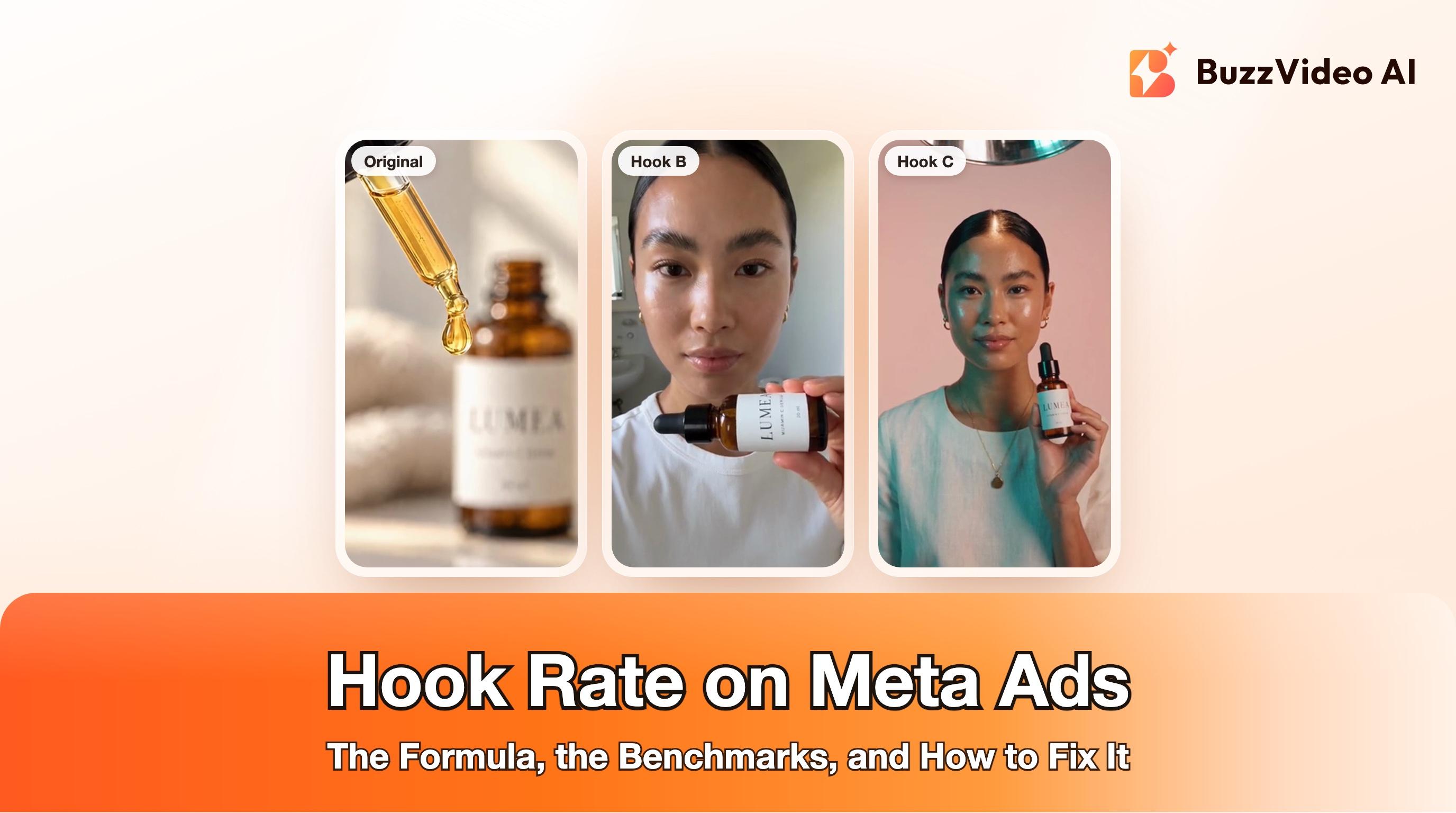
A low hook rate is one of the cheapest problems in paid social to fix: you change only the first one to three seconds and keep the rest of the ad. That's the workflow we built into BuzzVideo AI's Ad Variations tool, and it's the reason this guide ends with hook templates you can paste and test.
What is hook rate in Meta ads?
Hook rate (also called thumbstop rate) measures how often your opening stops the scroll. It's built on Meta's 3-second video plays metric, which counts the times your video played for at least three seconds, or for 97% of its length if it's shorter than three seconds. Replays within the same impression don't count (Meta).
Because it only looks at the opening, hook rate isolates one creative decision: the first shot, the first line of copy on screen and the first sound. Click-through rate and cost per purchase mix in the offer, the landing page and the audience. Hook rate doesn't, which is what makes it useful for diagnosing creative.
Try it: have a video ad with a weak opening? Upload it to BuzzVideo's Marketing Agent, pick Ad Variations and ask for three new hooks on the same body. Make new hooks for one ad →
How do you calculate hook rate and hold rate?
| Metric | Formula | What it tells you |
|---|---|---|
| Hook rate | 3-second video plays ÷ impressions × 100 | Did the opening stop the scroll? |
| Hold rate | ThruPlays ÷ 3-second video plays × 100 | Did the people you hooked keep watching? |
| Hold rate (alternative) | Video plays at 50% ÷ 3-second video plays × 100 | Same idea for longer ads; some teams use this version |
A ThruPlay is a play to completion, or of at least 15 seconds if the video is longer (Meta). So for a 12-second ad, a ThruPlay means someone watched it to the end; for a 40-second ad, it means they reached 15 seconds. Whichever hold-rate version you choose, use the same one everywhere, because the two produce different numbers for the same ad.
A worked example
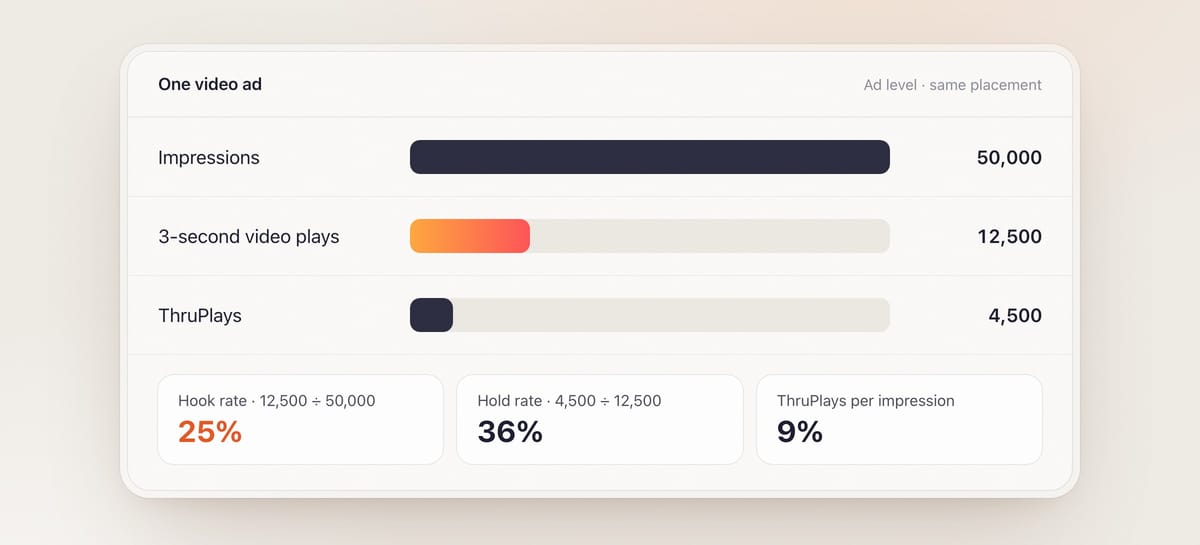
Say an ad served 50,000 impressions, got 12,500 3-second video plays and 4,500 ThruPlays.
- Hook rate = 12,500 ÷ 50,000 × 100 = 25%.
- Hold rate = 4,500 ÷ 12,500 × 100 = 36%.
- Put another way: 9% of all impressions turned into a ThruPlay (25% × 36%).
How do you add hook rate to Meta Ads Manager?
Meta lets you save your own formulas as custom metrics, from the Ads Manager table or from Ads Reporting (Meta). The menu names change from time to time, but the flow is:
- In Ads Manager, open the Columns menu and choose Customize columns.
- Click Create custom metric.
- Name it Hook rate and build the formula: 3-second video plays divided by Impressions. Set the format to Percentage (%).
- Create a second one called Hold rate: ThruPlays divided by 3-second video plays, also as a percentage.
- Add both to a column preset with Impressions, 3-second video plays, ThruPlays, CTR and your cost per result, and save the preset.
- Look at them at the ad level, not the campaign level, so each number belongs to one creative.
Before you share a custom metric across the ad account, check the formula. Meta's help page says a custom metric formula can't be edited or deleted once it's shared.
What is a good hook rate on Meta?
There isn't an official answer. Meta doesn't publish a hook-rate benchmark, and the ranges you'll find online come from agencies and analytics tools looking at their own clients. For example, Vaizle suggests aiming for roughly 20-25% hook rate and 40-50% hold rate for most accounts, and says top-performing ads can exceed 30% and 50% (Vaizle). Other guides quote different numbers. Treat any single figure as a rough starting point, not a pass mark.
Three things move the number more than the creative itself:
- Placement. Reels and Stories are full-screen and fast-swiping; feed placements are not. Compare Reels to Reels, not Reels to feed.
- Platform. TikTok's comparable metric is 2-second video views, a lower bar than Meta's three seconds (TikTok), so a TikTok hook rate isn't comparable with a Meta one.
- Audience temperature. Retargeting audiences already know you and often watch longer than cold audiences.
The benchmark that matters is your own: export the last 60-90 days of video ads, compute hook rate per ad and placement, and call anything in your top quarter a good hook.
What do your hook rate and hold rate tell you?
Read the two together. Each combination points to a different fix:
| Hook / hold | What's happening | What to change |
|---|---|---|
| Low / high | The opening doesn't stop the scroll, but viewers who stay like it | Only the first 1-3 seconds |
| High / low | The opening grabs attention, then the ad doesn't pay it off | The body after the hook |
| Low / low | Wrong angle, audience or product moment | A new concept, not a new hook |
| High / high | The video works | Offer, landing page, price or audience |
The first row is the most efficient to fix, because the expensive part of the ad (the product demo, the proof, the offer) already works.
How do you improve hook rate?
A hook is not just a line of text; it's what the viewer sees and hears in the first moments with the sound off. These are the hook types we test most often, all of which can be generated from your existing product images:
| Hook type | First 2 seconds | Works well for |
|---|---|---|
| Problem shown | The problem happens on screen before the product appears | Gadgets, cleaning, skincare |
| Product reveal | Extreme close-up of the product moving into frame | Beauty, drinks, anything with a satisfying texture |
| Creator to camera | A person looks at the lens and reacts or starts a sentence | TikTok-style UGC, apps, services |
| Result first | The after state, then cut back to how you got there | Before-and-after categories |
| Pattern break | An unexpected scale, angle or object (a giant product, an odd setting) | Saturated categories where every ad looks alike |
Here is a hook brief you can paste into BuzzVideo's Marketing Agent, or any AI video tool, to generate replacement openings for an existing ad:
“I'm attaching a video ad. Keep everything after [timestamp, e.g. 2.5 s] unchanged. Write three new openings, each 2-3 seconds, that cut cleanly into the existing next shot: (1) a problem-shown hook where [the problem] is visible before the product appears, (2) a close-up product reveal of [product] on [surface], (3) a creator in [setting] looking at camera and reacting. Same lighting and colour as the original, 9:16, no on-screen text, no logos, no prices. Show me the plan and the credit cost before generating.”
- Template: replace the brackets. Add captions and offers in editing, after you've picked the winning hook.
The video below shows what the output looks like: the original opening plus two new creator openings, all cutting into the same body from 2.4 seconds onwards.
How should you test new hooks?
Hook tests are cheap only if you read them cleanly. This is the structure we recommend:
- Change one thing. Each variant keeps the same body, offer, caption and landing page. If you also change the music, you won't know what worked.
- Keep the original as control. Run it alongside three or four new hooks in the same ad set, so they share budget and audience.
- Wait for enough impressions. A hook rate from a few hundred impressions is noise. Give each variant a few thousand impressions before you compare.
- Decide on hook rate, confirm on cost. Hook rate tells you which opening stops people; cost per result tells you whether it also sells. Keep the variant that wins both.
- Feed the winner forward. Use the winning hook type as the brief for the next round, and try it on your other best-selling products.
Meta's delivery system rewards a range of genuinely different creatives, not tiny edits; our guide to Meta Andromeda and creative diversity explains why. Hooks with different subjects (a hand, a face, a product close-up) are more distinct than three text overlays on the same shot. For a full testing cadence, see the ad variants sprint playbook.
If the new openings use realistic AI-generated people, add the AI disclosure when you upload; our AI ad labeling guide covers what Meta and TikTok expect.
Turn one ad into a hook test today
Pick the ad with the best hold rate and the weakest hook rate in your account. That's the one where a new opening has the most upside. In BuzzVideo's Marketing Agent, Ad Variations spins one ad into hook variants, and Video Batch Variations generates several different hooks or endings in one go for A/B testing. Both need a paid plan, because video generation starts on Starter ($14 a month billed yearly, 1,900 credits a month); the Free plan covers images only (pricing).
FAQs
What is the hook rate formula for Facebook ads?
Hook rate = 3-second video plays ÷ impressions × 100. Meta doesn't show it as a standard column, so create it as a custom metric in Ads Manager.
What is a good hook rate on Meta ads?
Meta publishes no official benchmark. Third-party guides vary; Vaizle, for example, suggests about 20-25% (Vaizle), but placement and audience change the number a lot, so compare against your own ads in the same placement.
What is the difference between hook rate and hold rate?
Hook rate measures whether the first three seconds stop the scroll. Hold rate (ThruPlays ÷ 3-second plays) measures whether the people you hooked kept watching.
Is hook rate the same as thumbstop ratio?
Yes. Thumbstop ratio is another name for the same calculation: 3-second video plays divided by impressions.
How do you calculate hook rate on TikTok?
Use 2-second video views ÷ impressions, because TikTok reports 2-second and 6-second views rather than 3-second plays (TikTok). Don't compare the result directly with a Meta hook rate.
Why is my hook rate high but my sales low?
The opening works but something after it doesn't: the body doesn't deliver on the hook, or the offer, price or landing page loses people. Check hold rate first, then CTR and landing-page conversion.
How many hooks should I test at once?
Three to four new hooks plus the original as control is enough for most budgets. More variants split spend too thinly to read the result.
Last verified: November 13, 2026, against our live pricing and product pages and Meta's and TikTok's metric definitions linked above.
Next reads: Ad hook variations with AI · Meta Andromeda and creative diversity · Ad variants sprint playbook · Advantage+ creative enhancements

About the author
Monica
Product Manager
As a Product Manager at BuzzVideo AI, I work with marketers and growth teams on AI ad workflows—from brief to shippable creatives. I write about practical product workflows, model choices, and how teams turn product pages into ads that feel native on Meta and TikTok.