Meta Andromeda Creative Diversity: AI Playbook (2026)
What Meta's Andromeda update means for your creatives, how Meta tells a new concept from a variation, and how to build a diverse ad set from one product with AI.
Meta Andromeda is the retrieval system that decides which ads even get considered for each person on Facebook and Instagram. Because Meta groups ads that look or feel alike and treats them as variations of one creative, ten near-identical versions of the same ad behave like a single entry. Creative diversity means giving Andromeda genuinely different concepts — different personas, formats, settings and stories — instead of more copies of one idea.
This guide covers what Meta has actually published about Andromeda and creative diversification, how to tell a new concept from a variation, and a step-by-step way to build a diverse ad set from one product with BuzzVideo AI's Marketing Agent — with the real images, prompts and credit costs from our own test.
Try it: Upload one product photo and ask the Marketing Agent for four concepts aimed at four different buyers. Open the Marketing Agent →
What is Meta Andromeda, and what changed in October 2026?
Andromeda is the first stage of Meta's ads pipeline. When someone opens Facebook or Instagram, retrieval narrows a huge pool of eligible ads down to a few thousand candidates, and a heavier ranking model then picks what actually shows. Meta first described Andromeda in a December 2024 engineering post.
On October 28, 2026, Meta published the next generation of Andromeda. The headline points for advertisers:
- It now scores every eligible ad and surfaces top candidates at over one billion ads per second, which Meta calls a 100x lift over the 2024 system.
- Meta says that since 2025, Andromeda has delivered a 2.4% increase in conversions on Facebook. (It is Meta's own figure; the post gives no baseline or method.)
- Meta also notes that generative AI creative tools have helped advertisers create hundreds of millions of new ads, which is why the candidate pool keeps growing.
That last point is the practical one. If everyone can now make 50 versions of an ad in an afternoon, volume stops being an advantage. What still helps is giving the system options that are actually different, so it has something new to match to different people.
What does Meta count as the same creative?
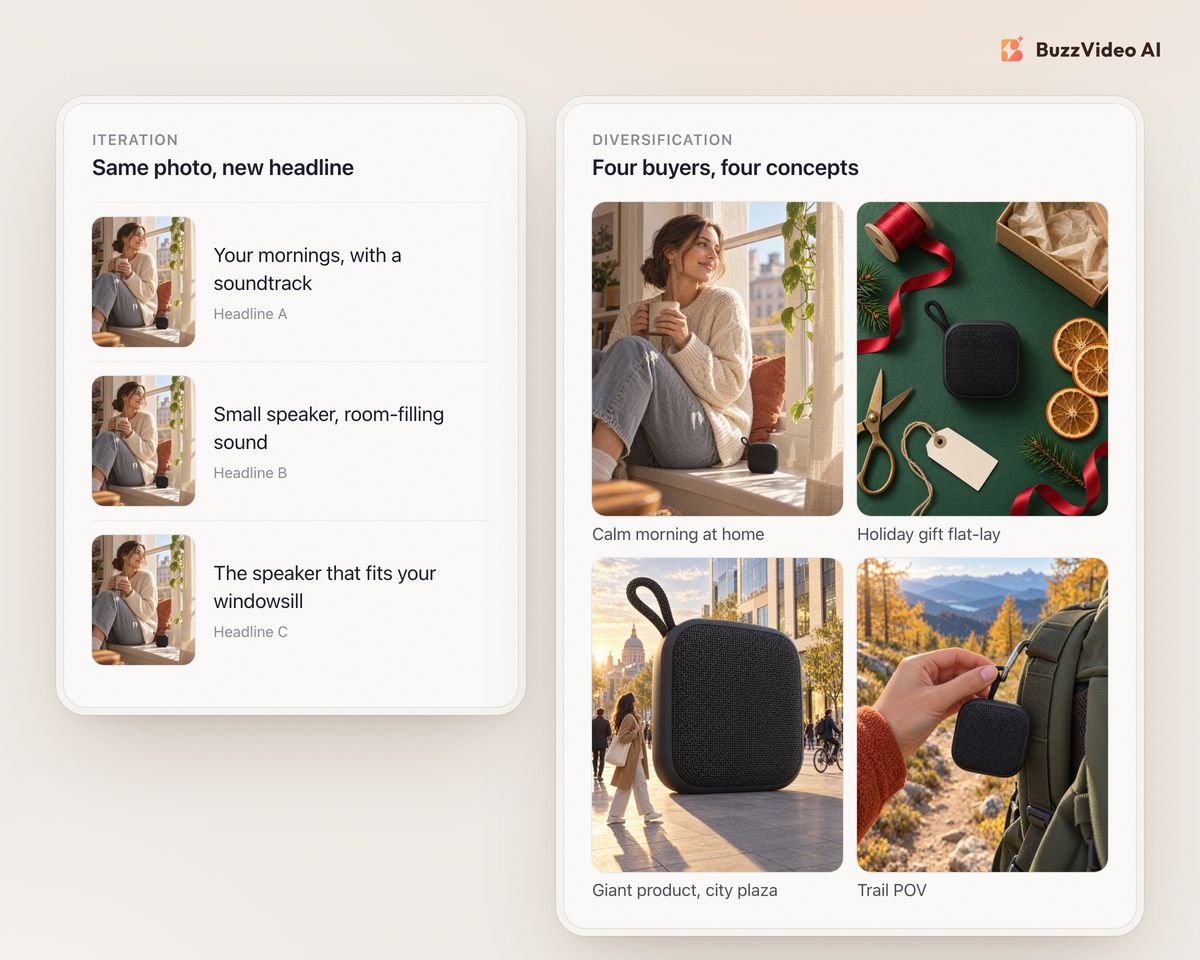
Meta answered this directly in Demystifying Creative Diversification (December 16, 2025). Its ads system groups ads that share key visual and thematic attributes. When ads look or feel alike, they are seen as variations of the same creative, and learnings and delivery optimizations are shared at the creative level, not per ad. Meta's own example: two ads with identical visuals and different text CTAs are iteration; a Reels ad made for Gen Z and a separate partnership ad with a creator who speaks to new moms are diversification.
Ads Manager is also testing a Creative diversity metric. Meta describes it as estimated and in development: it compares the images and video thumbnails in an ad set and labels the set High, Medium or Low diversity. You can add it as a column when it is available in your account. Meta separately distinguishes creative fatigue (people have seen the same ad too often) from creative similarity (your ads look too alike, even if they are technically different files).
| Creative iteration | Creative diversification | |
|---|---|---|
| What changes | Headline, CTA, crop, color, first line of copy | Persona, format, setting, story, who is on screen |
| How Meta treats it | Likely grouped as one creative | Treated as separate creatives |
| Best for | Refining a concept that already works | Reaching new audiences and avoiding similarity |
| Example | Same lifestyle photo with three headlines | Lifestyle photo, gift flat-lay, giant product, POV video |
What makes two ads different enough?
Meta has not published a similarity threshold, so treat this as a working checklist rather than a rule. In our experience, a new concept changes at least two of these five things, and the first frame always changes:
| Lever | Same concept (iteration) | New concept (diversification) |
|---|---|---|
| Persona | Same buyer, new wording | A different buyer with a different reason to buy |
| Format | Same 4:5 photo | Flat-lay, creator video, POV, unboxing, giant product |
| Setting | Same room, new crop | Home vs street vs outdoors vs studio |
| Story | Same benefit, new adjective | Gift, daily ritual, adventure, problem and fix |
| Opening frame | Same first second | A different first image in the feed |
Notice what is not on the list: button color, headline synonyms and small crops. Those are still worth testing, but inside a concept, after Andromeda has found who it works for.
How do you build a diverse Meta ad set with AI?
Here is the workflow we used for a fictional mini speaker, starting from a single product photo. It takes about an hour, most of it spent reviewing.
Step 1: Write down three or four buyers, not three or four headlines
For each persona, write one line: who they are, when they would use the product and why they buy. For our speaker: a remote worker who wants a calmer morning, someone buying a holiday gift, a weekend hiker and a scroller who only stops for something surprising. Meta's own best practices say the same thing in different words: segment your messaging by motivation or use case.
Step 2: Give each buyer a different format
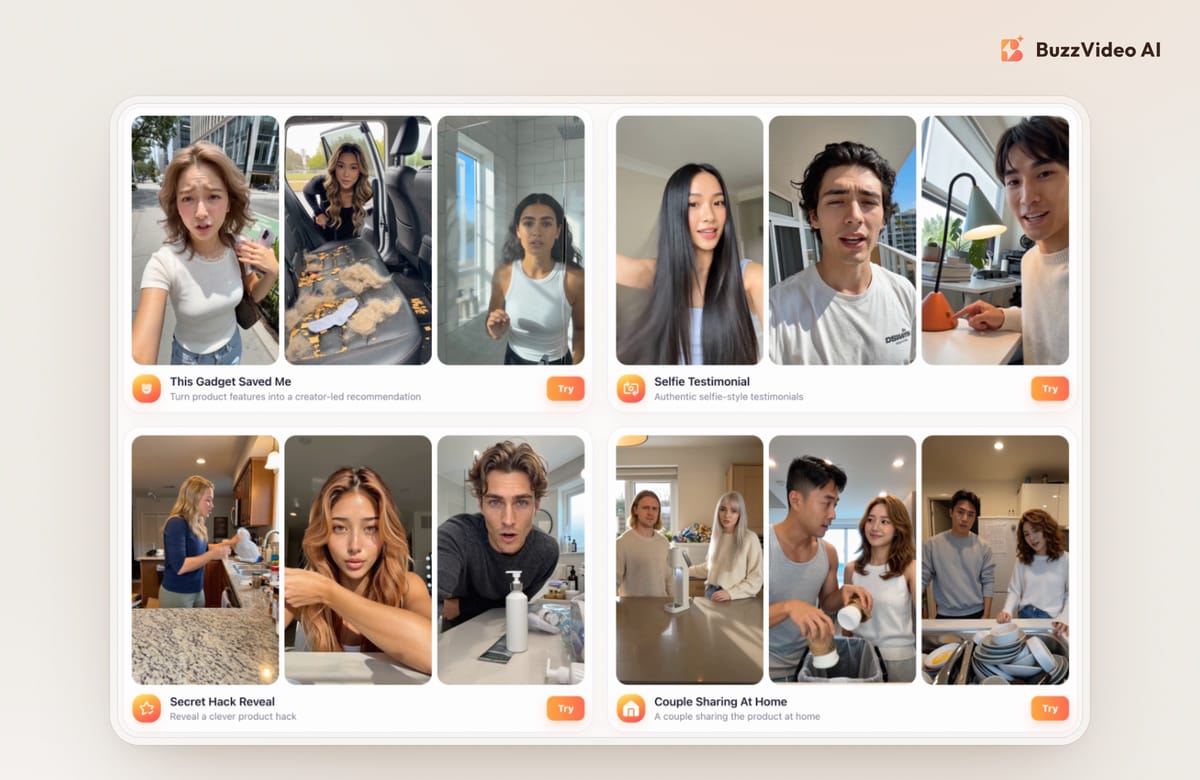
Match a format to each persona so the ads look different before anyone reads a word. The Marketing Agent template library is a quick source of formats that already run as native-looking social ads: This Gadget Saved Me, Selfie Testimonial, Secret Hack Reveal, Couple Sharing At Home, Direct-to-Camera, Camera POV, Before and After, Unboxing ASMR and Giant Figure, among others.
Step 3: Make one hero static per concept from the same product reference
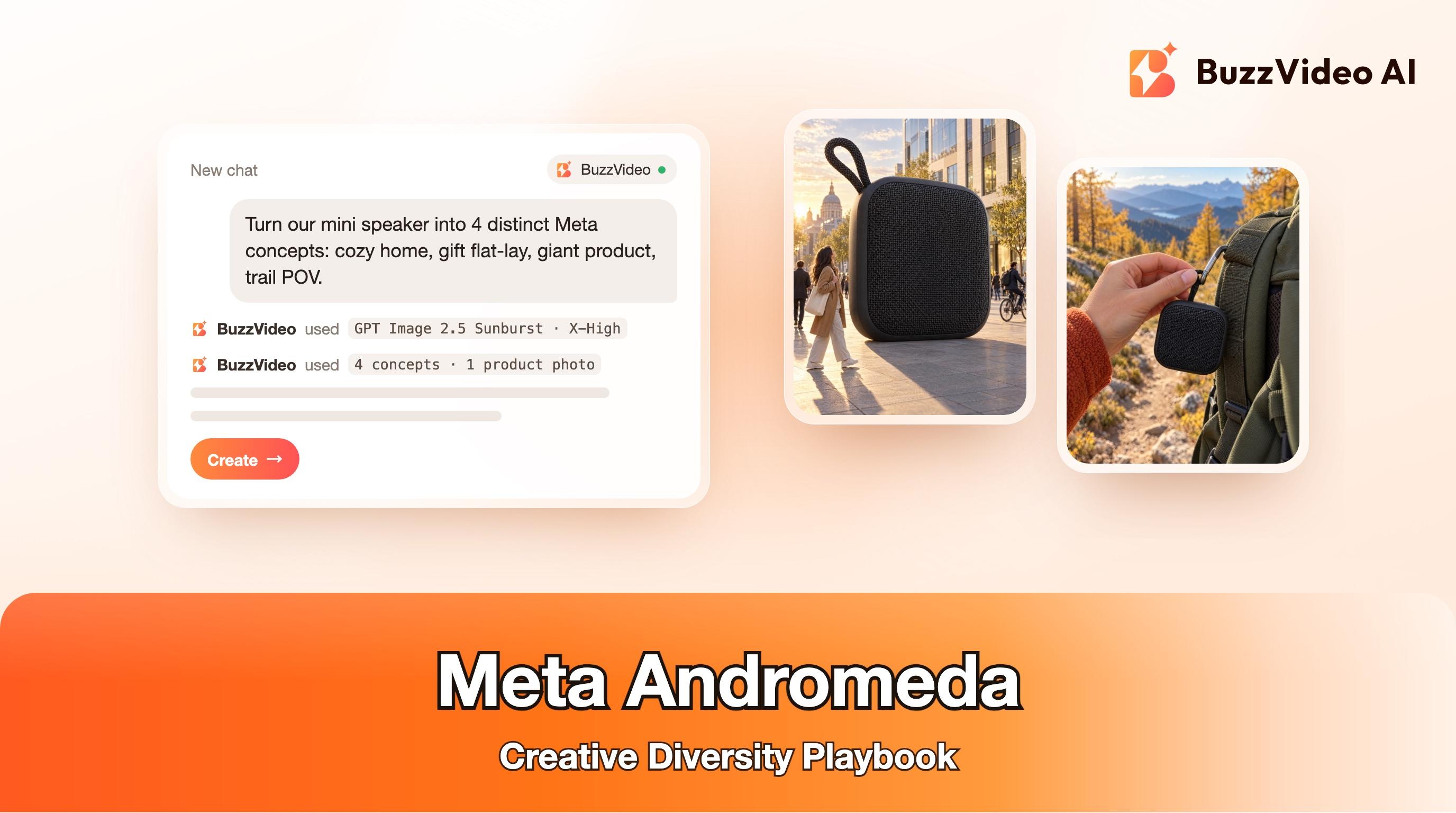
Upload a clean product photo and generate one image per concept. Keep the product description identical in every prompt so the product stays accurate, and change everything else: person, place, light, camera angle. Leave prices and offers out of the generated image and add them in editing. The four speaker concepts in the figure above were made this way: one product photo, four prompts, no retouching.
Step 4: Turn two or three concepts into video
Video gives Andromeda a different surface (Reels and Stories) as well as a different look. Pick the concepts with the clearest action — a POV clip-on moment, an unboxing, a creator talking to camera — and build them with the UGC Ads, Product Demo or Video Clone tools (UGC Ads starts you on Seedance 2.5). Our AI UGC ads guide and unboxing video guide go deeper on each format.
Step 5: Iterate inside each concept, not across them
Once a concept is live, use Ad Variations or Video Batch Variations to make new hooks and endings for it. That is where a hook variations workflow or a 50-variant sprint still pays off — as refinement of concepts that already have an audience, not as a substitute for new concepts.
Step 6: Launch, then read similarity and fatigue separately
Put the distinct concepts in the same ad set so the system can choose between them. If the Creative diversity column shows Low, add a new concept rather than another variation. If results drop on a concept that used to work, that is more likely fatigue: refresh that concept with a new opening frame or a new person.
Copy-paste prompts for a concept set
Use this brief in the Marketing Agent first, then the image prompt for each concept. Swap in your own product and personas.
“Here is my product photo. Build 4 distinct Meta ad concepts for it, one per buyer: (1) remote worker, calm morning at home; (2) holiday gift buyer; (3) weekend hiker; (4) scroller who needs a surprise. For each concept give: format, setting, who is on screen, opening frame, one-line hook. No two concepts may share a format or a setting. Do not put prices, discounts or dates in any image.”
- Marketing Agent concept brief
“Use ONLY the product from the reference image. [Describe the product exactly: size, material, color, straps, buttons.] Scene: [persona] in [setting], [action], [light]. 4:5, photorealistic, editorial but candid. Must NOT appear: any text, letters, numbers, logos, watermarks, extra copies of the product. Hands have five fingers.”
- Image prompt per concept (GPT Image 2.5 Sunburst, X-High)
How many creatives does an ad set need?
Meta has not published a required number. You will see figures like 10 to 15 assets per campaign in agency posts, but those are opinions, not Meta guidance. A practical starting point for a small brand is four to six distinct concepts per ad set, with two or three iterations of each once you know which ones work. Add concepts when the diversity column is Low or when every ad in the set opens the same way.
What does a diverse ad set cost on BuzzVideo?
Costs below come from our live pricing page and from what our test was charged today. Your exact cost depends on model, length and resolution, and the Create button shows the credits before you run anything.
| Item | Model and settings | Credits |
|---|---|---|
| 4 concept statics (our test) | GPT Image 2.5 Sunburst, X-High, 4:5 | 15 each, 60 total |
| Creator or POV video (UGC Ads default) | Seedance 2.5, HD, 10 s | 417 per video |
| Same video on the Starter plan | Seedance 2.0 Fast, SD, 10 s | 98 per video |
| Short product motion on Starter | Kling 3.0, 5 s | 63 per video |
So four statics plus three Seedance 2.5 videos come to roughly 1,311 credits before any rerolls, which fits inside the Pro plan's 4,900 monthly credits ($35 a month billed yearly). Seedance 2.5 needs Pro or Ultra. On Starter (1,900 credits, $14 a month billed yearly), making the three videos with Seedance 2.0 Fast instead brings the set to about 354 credits. Free accounts can make images but not videos.
What mistakes make a set look the same to Meta?
- Same opening frame. If every ad starts on the same packshot, the ads look alike in the feed even with different middles.
- Same person in every video. One AI presenter across ten ads reads as one concept; give each concept its own person or no person at all.
- Text-only changes. New headlines on the same image are iteration, which is fine, but do not count them as new concepts.
- One setting for everything. A white studio for every concept collapses the look; move at least one concept outdoors or into a real home.
- Rebuilding a winner too often. Meta separates fatigue from similarity; a fatigued winner needs a refresh, not to be cloned ten times.
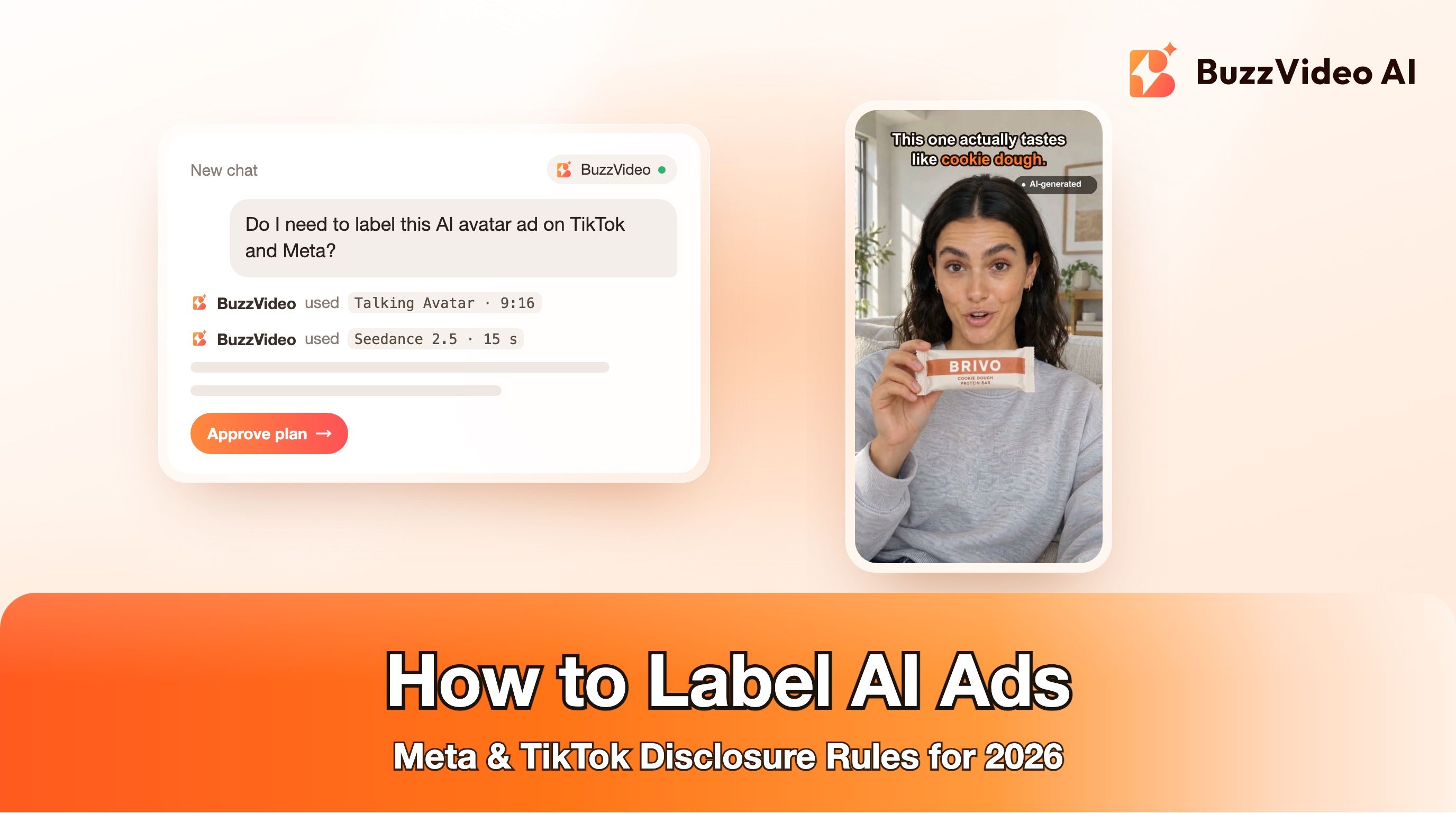
One more rule that applies to every concept: Meta shows an "AI info" label on ads made or significantly edited with generative AI, including ads it detects were made with third-party tools. Our guide to labelling AI ads on Meta and TikTok covers when that applies.
Build your first diverse ad set
Start from one product photo, four buyers and four formats. Make the statics first, because they are cheap and quick to judge, then turn the strongest two into video for Reels. With Black Friday on November 27, a set of genuinely different concepts gives Andromeda more to work with than another round of headline tests.
FAQs
What is the Meta Andromeda update?
Andromeda is Meta's ads retrieval system, the stage that picks a few thousand candidate ads for each person. Meta's October 28, 2026 update says the new version scores every eligible ad at over one billion ads per second, about 100x the 2024 system.
Does Meta Andromeda reward creative diversity?
Meta says ads that look or feel alike are treated as variations of the same creative, and recommends ads that are truly different in look, feel, storyline and message. Distinct concepts give the system more options to match to different people. Source: Meta for Business.
What is the creative diversity metric in Meta Ads Manager?
It is an estimated metric, still in development, that compares the images and video thumbnails in an ad set and labels the set High, Medium or Low diversity. Meta's Help Center describes how it is calculated.
Is creative iteration still useful after Andromeda?
Yes. Iteration (new hooks, headlines and CTAs) refines a concept that already works. It just should not replace new concepts, because Meta groups look-alike ads as one creative.
How many ads should I put in one Meta ad set?
Meta has not published a number. A practical start is four to six distinct concepts per ad set, with two or three iterations of each once you see which concepts get traction.
Can AI-generated images count as different concepts?
Yes, if the concepts are actually different: a different persona, format, setting and opening frame. Ten AI images of the same scene with small changes are still one concept.
Do AI-made Meta ads need an AI label?
Meta applies an "AI info" label to ads made or significantly edited with its own generative AI tools, and since its June 2026 update it has started detecting third-party AI tools through industry-standard signals. See Meta's AI transparency update and our labelling guide.
Last verified: November 6, 2026, against our live pricing and product pages.
Next reads: Black Friday video ads · AI static ads for Meta · Ad hook variations with AI · Competitor ad research with AI

About the author
Monica
Product Manager
As a Product Manager at BuzzVideo AI, I work with marketers and growth teams on AI ad workflows—from brief to shippable creatives. I write about practical product workflows, model choices, and how teams turn product pages into ads that feel native on Meta and TikTok.